Tool against Hate Speech and Fake News
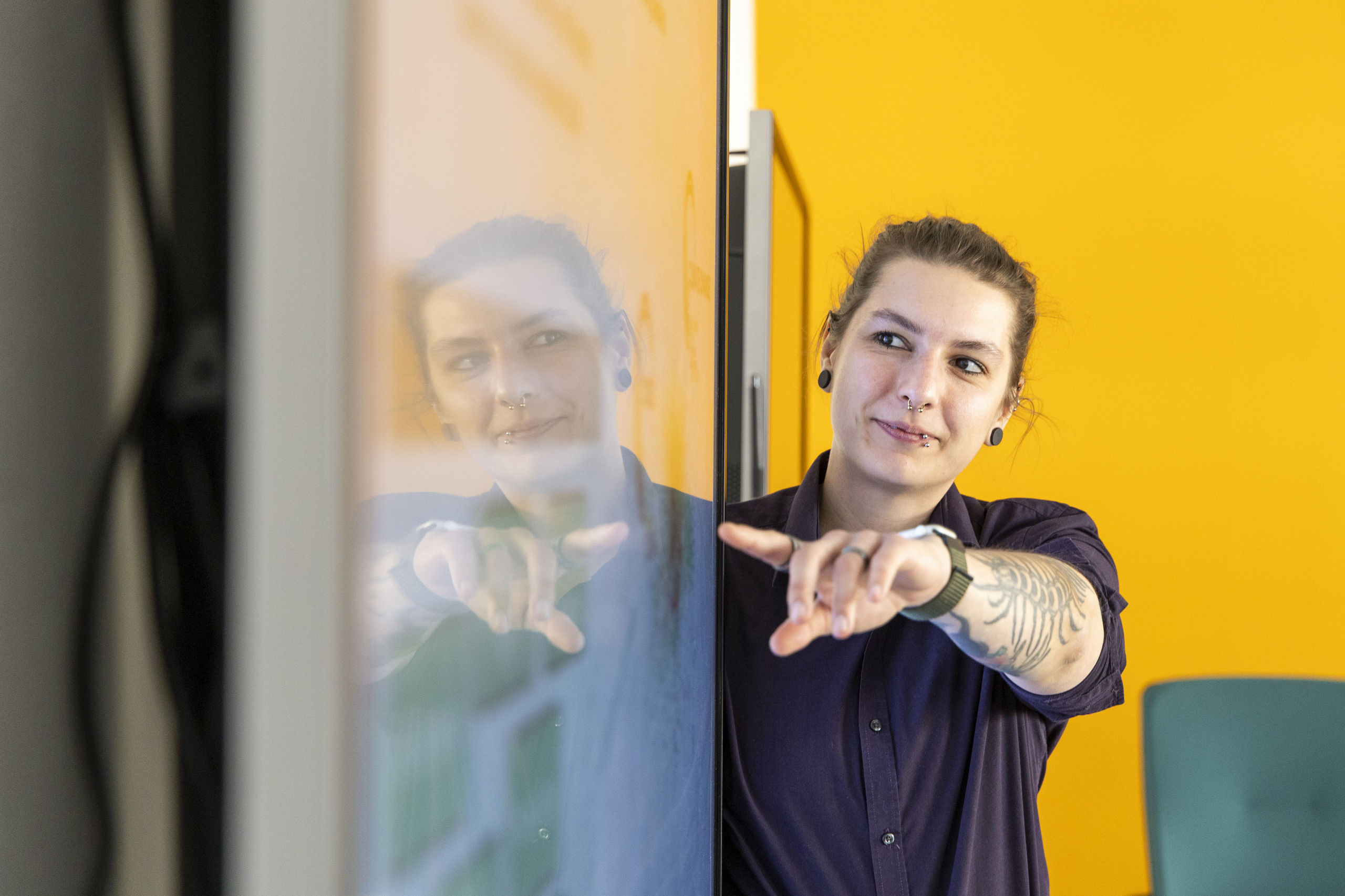
Five years of research, a 500-page doctoral thesis – and a change in perspective: the work conducted by Mina Schütz, computer scientist at h_da, in the frame of her doctoral studies points to new approaches for dealing with disinformation, propaganda, conspiracy theories and hate speech on the internet. Instead of classifying content as “true” or “false”, the “DisDETECT” analysis tool, which she developed as part of her doctoral project, is based on differentiation and transparency. By combining over 50 characteristics to evaluate texts and identify patterns, the tool gives experts a basis for making informed decisions: it is not the technology that decides, but the human being. AI and data science expert Mina Schütz completed her doctoral thesis at the Doctoral Centre for Applied Computer Science (PZAI) in cooperation with the Austrian Institute of Technology (AIT).
Interview: Christina Janssen, 29.4.2026
impact: We all scroll through news and social media every day – often with mixed feelings. From your perspective as a researcher, have hate speech and disinformation increased over the past few years?
Schütz: The problem has in any case become more widespread. When I started, it was still purely a topic associated with the detection of fake news, above all in the US. Today, it’s a huge issue in Europe too. News spreads rapidly via social media, and on top of that there is AI-generated content. People often just scroll over texts and rarely read them in detail. This has given the topic greater urgency.
impact: What happens in society when we are no longer able to reliably distinguish between bona fide information and manipulated content?
Schütz: First and foremost, it creates uncertainty, and trust in the media diminishes. Many people no longer know which sources they can trust and lack a sense of orientation within society.
impact: Does this contribute, in your opinion, to rising social tensions?
Schütz: Yes, I assume it does. In recent years, for example, we have seen deepfakes that have influenced real political events. And this problem is not going to disappear.
Tool for editorial teams, academia and politics
impact: Your DisDETECT system aims to remedy this: Who reaps a specific benefit from it – journalists, public authorities and platform operators – or ordinary users as well?
Schütz: It is suitable for everyone dealing more closely with the topic of disinformation – whether in an academic context or in journalism. In other words, all those confronted with this phenomenon on a daily basis and who have a deeper understanding of it, such as editorial teams. The tool supports their work by presenting complex information in a structured way. How they interpret that information is, however, down to them.
impact: How exactly does it work?
Schütz: DisDETECT is a web-based analysis tool for examining large amounts of text systematically. Users can enter and evaluate texts or datasets. For example, you can examine which topics featured prominently in the news recently. But you can also examine individual news articles or other texts in greater detail. The system then analyses the text’s various characteristics – for example, whether the wording is emotional or neutral, whether there are elements of hate speech, or whether there are signs of clickbait. It’s not a matter of making a binary decision about whether something is true or false, but instead of saying “Caution! An expert should take a closer look at topic X or text Y”.
Traffic lights, not verdicts: How the tool works
impact: Hence it’s not about fact checks like we are familiar with, but about a differentiated analysis.
Schütz: Exactly. DisDETECT does not make any final decisions. The system rates individual texts on a graded scale.
impact: Like traffic lights?
Schütz: Like traffic lights, but with four colours: green, yellow and red – plus orange: These represent four levels from trustworthy to critical.
impact: How does the system make its assessment?
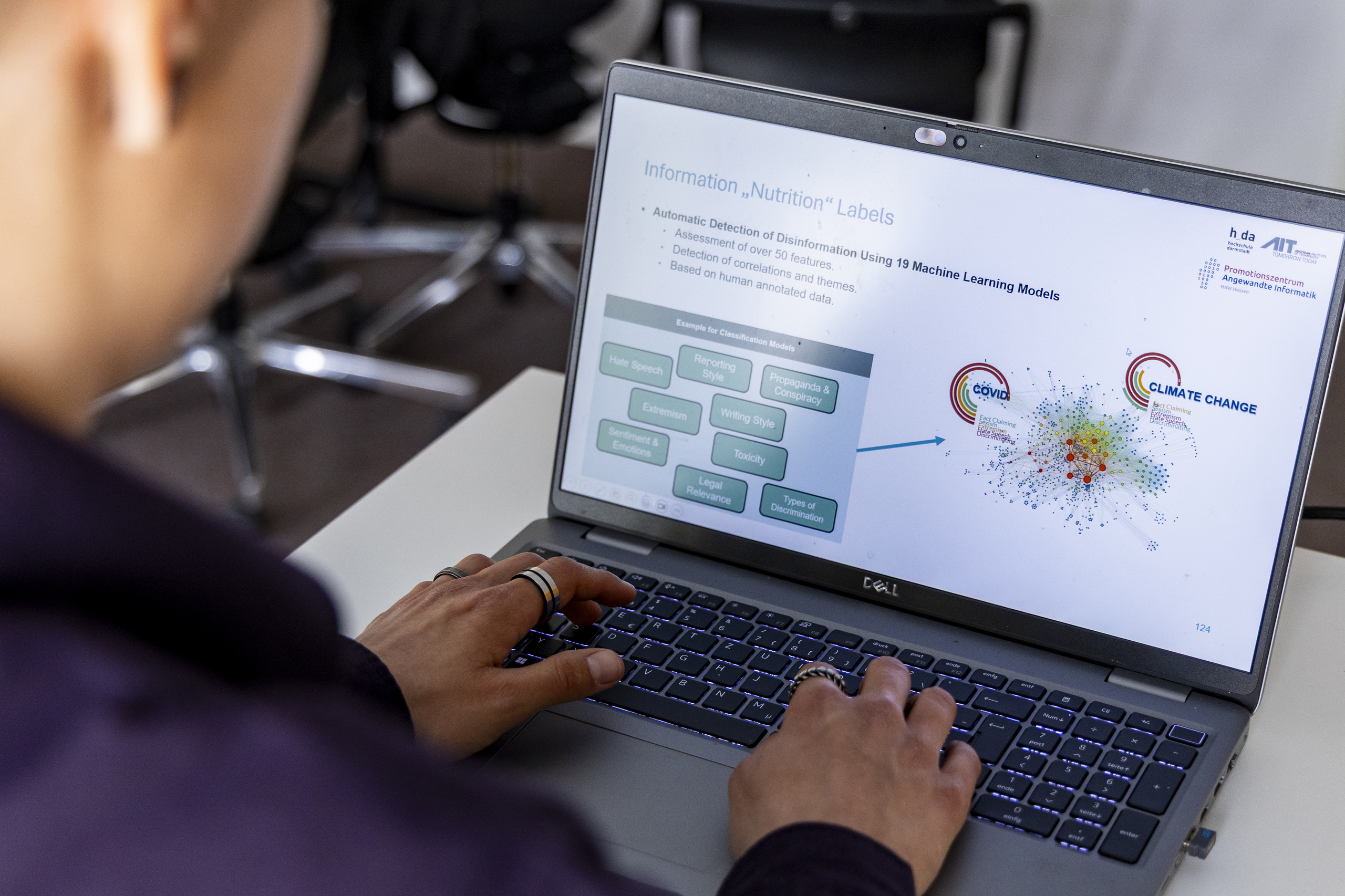
Schütz: It has 19 AI models working in the background that analyse a text’s various characteristics. The system then amalgamates these analyses to produce a single result. In other words, the results from the individual AI models are combined. The confidence interval is also indicated so that users know the probability of the system being mistaken.
More than just “true” or “false”: 50 characteristics come into play
impact: What’s new about this approach?
Schütz: I consciously go beyond the conventional logic of true or false. The analysis tool takes over 50 characteristics into account that are typical of hate speech, fake news or clickbait. Disinformation is complex. A text can be factually correct yet still have a manipulative effect – or vice versa. By combining various signals, the system can produce a sound assessment.
impact: How are the results presented so that they are user-friendly?
Schütz: Through visual analytics: the results are presented in an interactive format. The web interface is designed in such a way that the user, as the “human in the loop”, has a lot of freedom when choosing how the information is displayed. One of the kex components is “knowledge graphs” that combine the results generated by the AI tools with knowledge on the relevant topics collected from databases such as DBpedia.
impact: What knowledge and skills do I need to be able to use the tool?
Schütz: Some training is indeed necessary. If I’m using AI systems in my everyday work, I need to have at least a basic idea of how they work.
impact: How accurate is DisDETECT?
Schütz: The individual models achieve accuracies ranging from 80 to 97 percent – depending on the task. However, it’s not the individual results that are important, but how the different models work together.
impact: The rapid development of AI has swept over your field of research like an enormous wave. How has that changed your work?
Schütz: I was right in the middle of my experiments when ChatGPT was released, which of course led me to ask myself: Okay, might a large language model do this better? Fortunately, it emerged that this isn’t the case. We tested how well a large language model can assess whether a post contains hate speech, for example. Depending on the model, the degree of accuracy varied by 50 percent. In one test run, a large language model showed an accuracy of just 10 percent, in contrast to the 80 or 90 percent that DisDETECT achieves. The more complex the tasks are, the more difficult it becomes for models such as ChatGPT.

Test run: Linking research and practice
impact: You had potential users test the system. What was the outcome?
Schütz: In brief, they think the system is great, and the feedback was very positive. However, as it is still a prototype, there are still one or two things that could be improved. For example, how the knowledge graph is displayed, or the question of at which point the analyses become too difficult for which users. A data analyst might still understand a certain degree of complexity, but a journalist would need more training. Overall, however, I’m very satisfied with the feedback from my test users.
impact: Is DisDETECT ready for use?
Schütz: Not quite. It’s a prototype with a low technology readiness level. To be used on a large scale, it needs further development and implementation, which is why the research work is continuing. Detecting disinformation is highly topical, and the demand for such tools is growing.
Related articles
impact, 20.9.2021: TRAWLING FOR HATE IN THE NETWORK
impact, 8.6.2020: Fake News – „Nicht jeden Beitrag sofort teilen“ (in German only)
impact, 8.3.2019: Hassrede – „Den Trollen trotzen“ (in German only)
Contact our Editorial Team
Christina Janssen
Science Editor
University Communications
Tel.: +49.6151.533-60112
Email: christina.janssen@h-da.de
Translation: Sharon Oranski