


Darmstadt stargazers

From now on, h_da students will be gazing at the stars from Kleiner Feldberg, a peak in the Taunus mountain range, where the university recently began operating its own research and teaching observatory. Computer science and mechanical engineering students are working together on an interdisciplinary basis to upgrade the operation and automation of astronomical telescopes.
By Simon Colin, 8.9.2026
Slightly hidden among the trees on Kleiner Feldberg, a peak in the Taunus mountain range, lies a fenced-off area: the site of the Hans-Ludwig Neumann Observatory of the Physical Society. The society’s long-established facility now has a neighbour: h_da’s new research and teaching observatory. Reiner Wichert, Professor of Computer Science, and his students built the observatory without any external assistance – from the concrete foundations, which they laid themselves, to the dome, which they assembled and adjusted by hand.
Sternwarte h_da_Drohnenvideo
A star is born: An interdisciplinary team of computer scientists and mechanical engineers aims to use h_da’s new research and teaching observatory to help improve astrophotography. Video: h_da / Markus Schmidt
The interdisciplinary team wants to help improve astrophotography in the future and is currently working on the “heavy-duty mount”. So that a telescope can produce the best possible images of stars, it requires a precise astronomical mount that is suitable for its respective weight and allows the telescope to tilt and rotate. Mechanical engineering students led by Professor Norbert Schneider are in the process of designing and developing such a mount for advanced telescopes of up to 150 kilograms in weight, paying particular attention to the choice of components, such as the motor, gear system and position sensor, and their precise interaction.
Blurred lines?
In parallel, Professor Reiner Wichert and his students are working on the smart control and automation of the observatory’s technology, with the aim of improving the handling of the heavy mount so that the telescope produces the sharpest possible images. To this end, the astro community is already working with established open-source software systems such as N.I.N.A., to which the h_da stargazers plan to contribute their own innovative ideas. Five projects are currently in progress.
The starting point for all good astronomy photos is the best possible polar alignment. To achieve this, an observatory must be aligned with the North Pole: once in the case of stationary observatories; for mobile observatories, every time they change location. Software calculates how far the mount deviates from the North Pole. Until now, this deviation has been corrected manually. “We want to replace this process with motors that correct the alignment automatically. There is currently no suitable solution for the heavy mount we are planning, which is why the students are transposing this principle to the required size and weight class,” says Professor Reiner Wichert.

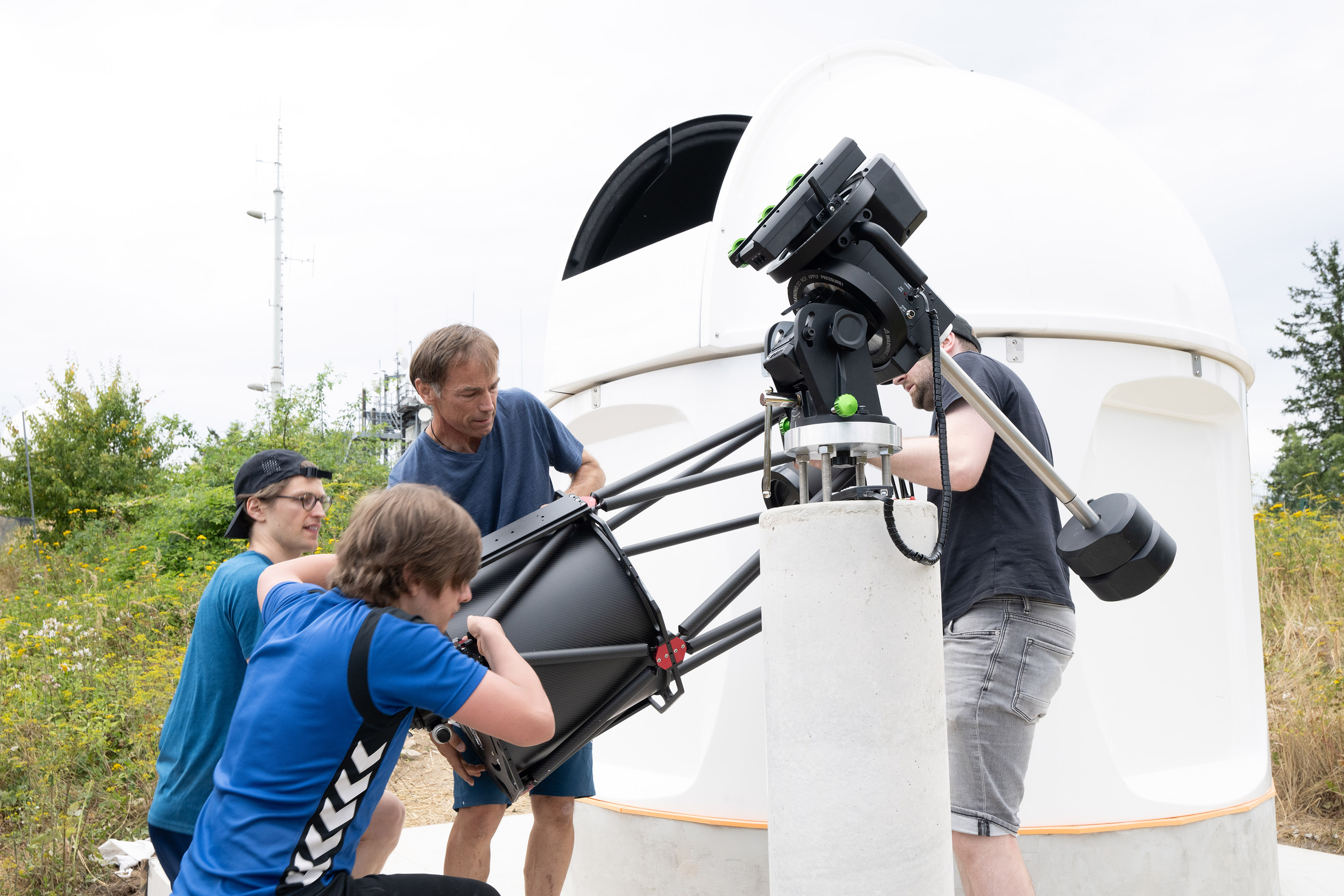

Once the mount has been precisely aligned with the north celestial pole, the next step is to lock onto the object of interest so that it is exactly in the centre of the image. Here, too, software that provides data on stars and whole galaxies is helpful. To this end, the students are exploring how machine learning can be applied to “adaptive pointing models”. This will make it possible in the future to find and lock onto specific objects even more quickly. The telescope can then start taking pictures. But especially in astrophotography, this can sometimes take several hours, depending on the exposure time, which is why a precise tracking system is necessary so that the stars do not end up looking like blurred lines. The sticking point is the mount’s gear system and motors, which can be prone to slight errors. “Our goal is to predict the behaviour of such tracking errors – particularly gear play – with the help of machine learning and using data as the basis, and to compensate for them in the future,” explains Professor Reiner Wichert.
Remote control
Another goal is the autonomous remote control of the university observatory. To this end, the students are developing mechanisms to control the mount, the telescope’s camera, the dome and the weather sensors remotely. In the future, it should be possible to start and end whole nights of observation remotely. This is particularly important in critical situations, for example when a storm is brewing. In such cases, the system should in the future be able to recognise critical conditions and initiate suitable protective measures. Finally, the students are developing a digital twin of the mount, using software to reproduce the behaviour of the real mount and the condition of the dome. This will facilitate tests and experiments without having to operate the real hardware continuously.
And what does a closer look at the stars tell us? Together with his students, Professor Reiner Wichert would also like to improve astrophotography itself. This includes software that reduces image noise even further, and image processing such as a technique called “stacking”, where several images of the same object are automatically aligned and superimposed using well-known programmes, such as Siril or Astro Pixel Processor, to reduce noise and make details more clearly visible. However, the selection of suitable images and their optimised processing have so far largely been left in human hands. In the future, AI-based methods could help to make this selection and processing more adaptive and automate some parts. Creative and technical image processing will, however, continue to be a human prerogative. And nothing can replace the view through a telescope anyway.
Related articles
impact, 02.02.2026: "HEAR, HEAR!"
impact, 23.07.2024: A SMALL STEP FOR A ROVER
impact, 26.11.2023: DIGITAL ASTRONAUTS
Contact our Editorial Team
Christina Janssen
Science Editor
University Communications
Tel.: +49.6151.533-60112
Email: christina.janssen@h-da.de
Translation: Sharon Oranski
Photography: Markus Schmidt