


Demokratie im Netz

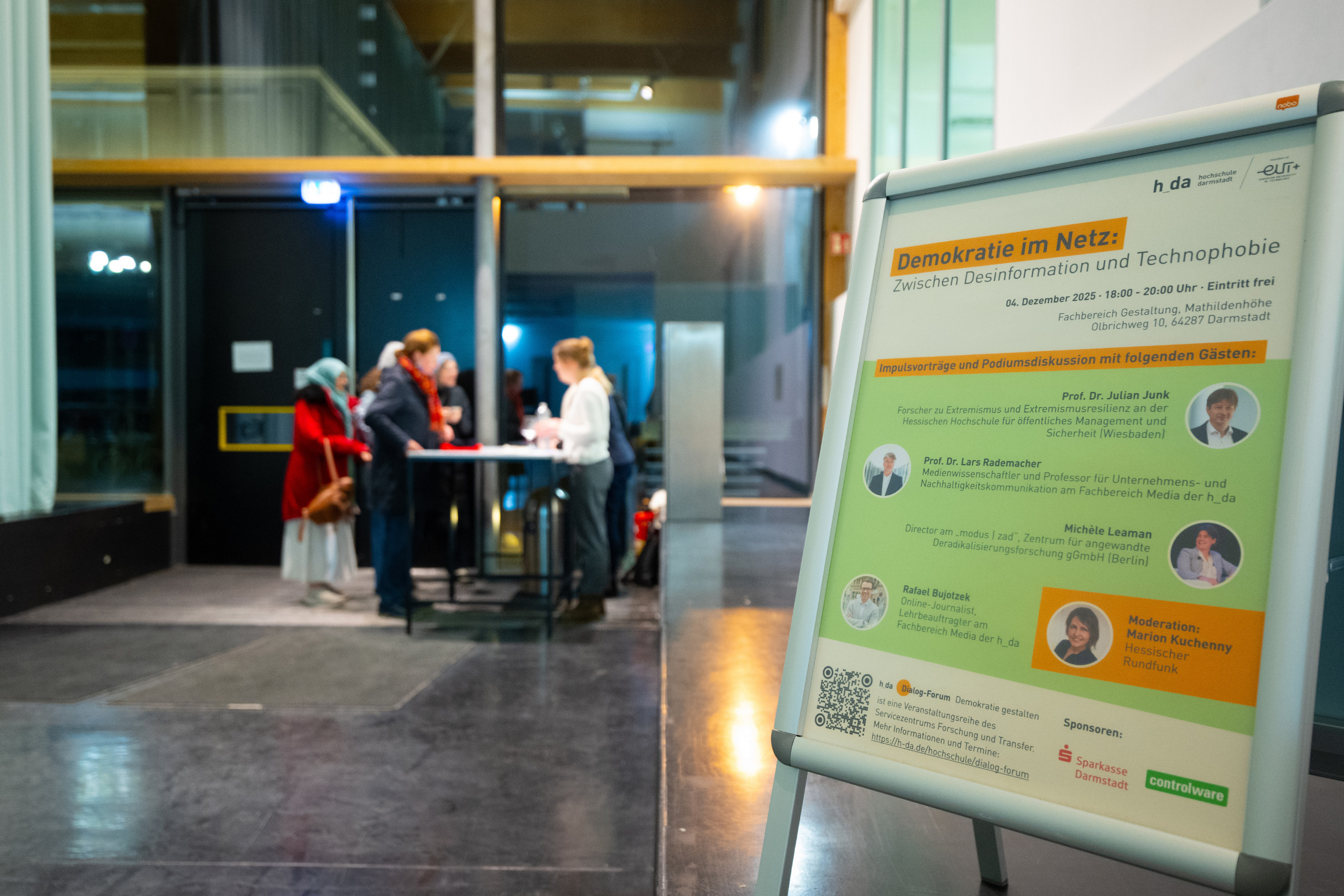
‘Democracy on the internet: between disinformation and technophobia’ was the theme on Thursday, 4 December, in the foyer of the Faculty of Design at h_da. Around 60 interested citizens came to Mathildenhöhe for the 6th h_da Dialogue Forum. They enjoyed informative presentations and a discussion that offered many concrete suggestions.
By Daniel Timme, 8.12.2025
Marion Kuchenny from Hessischer Rundfunk moderated the evening, which was opened with a welcome address by Prof. Dr Nicole Saenger, h_da Vice President for Research, Transfer and Sustainable Development. ‘We are seeing verbal abuse, hatred and incitement on an unimaginable scale online. We will have a lot to discuss!’ announced Kuchenny right at the start. With her questions and theories, she stimulated discussion and steered the conversation.
Two keynote speeches preceding the discussion laid the foundation and established points of reference. Prof. Dr Julian Junk, who researches extremism and extremism resilience at the Hessian University for Applied Sciences for Public Management and Security (HöMS) in Wiesbaden, opened his presentation with current findings on the crisis of representative democracy. The Leipzig authoritarianism study sees declining support for democracy. Particularly worrying: more than a fifth of those surveyed had no opinion on whether we should live in a dictatorship rather than a democracy. The quantity and quality of extremist aspirations and attitudes have increased since 2022. Feelings of insecurity and powerlessness in the face of crises, decline and danger are widespread. Added to this is a decreasing distancing from extremist attitudes.
The seriousness of the situation is being underestimated
‘The right wing is playing this game,’ said Junk. And he means that in the truest sense of the word: online games serve as bait for right-wing extremists. Extremist content can be found publicly via keyword searches. ‘Nazi Moorhuhnjagd’ (Nazi Moorhen Hunt) and ‘Zählen lernen mit Kalaschnikows’ (Learning to Count with Kalashnikovs) are relatively harmless examples of the misuse of gaming. Junk's conclusion: the seriousness of the situation and the need for regulation in the digital space are being underestimated. However, this also applies to the opportunities for activation, mobilisation and prevention for democracy.
The second keynote speaker, Prof. Dr Lars Rademacher, also navigated rather calm, constructive waters. The professor of corporate and sustainability communication at the h_da's Faculty of Media highlighted research findings on fake news and dispelled ‘misinformation on disinformation’. ‘The public discourse on misinformation and disinformation is characterised by fears and concerns, but rarely reflects the state of research,’ said Rademacher. The reach and impact of fake news tend to be less than publicly assumed. The intense public debate on the issue makes the problem appear greater than it actually is.
Fake news is particularly effective among people who know little about a topic, have little interest in it, and trust the source. Therefore, false news spread by prominent or authoritative figures is especially effective. A minority consumes a great deal of disinformation, but seeks it out specifically to confirm existing beliefs. However, the majority of recipients come into contact with fake news too rarely to be truly influenced by it. Rademacher's advice: ‘Use your common sense!’
Rademacher also took a nuanced view of the much-cited polarisation, drawing on the work of authors Steffen Mau and Nils C. Kumkar. Although more and more people fear social division, this cannot be measured objectively. What is beyond doubt, however, is that social media has long since taken over the central role of traditional media offerings among younger generations.


Using humour to combat perceived reality
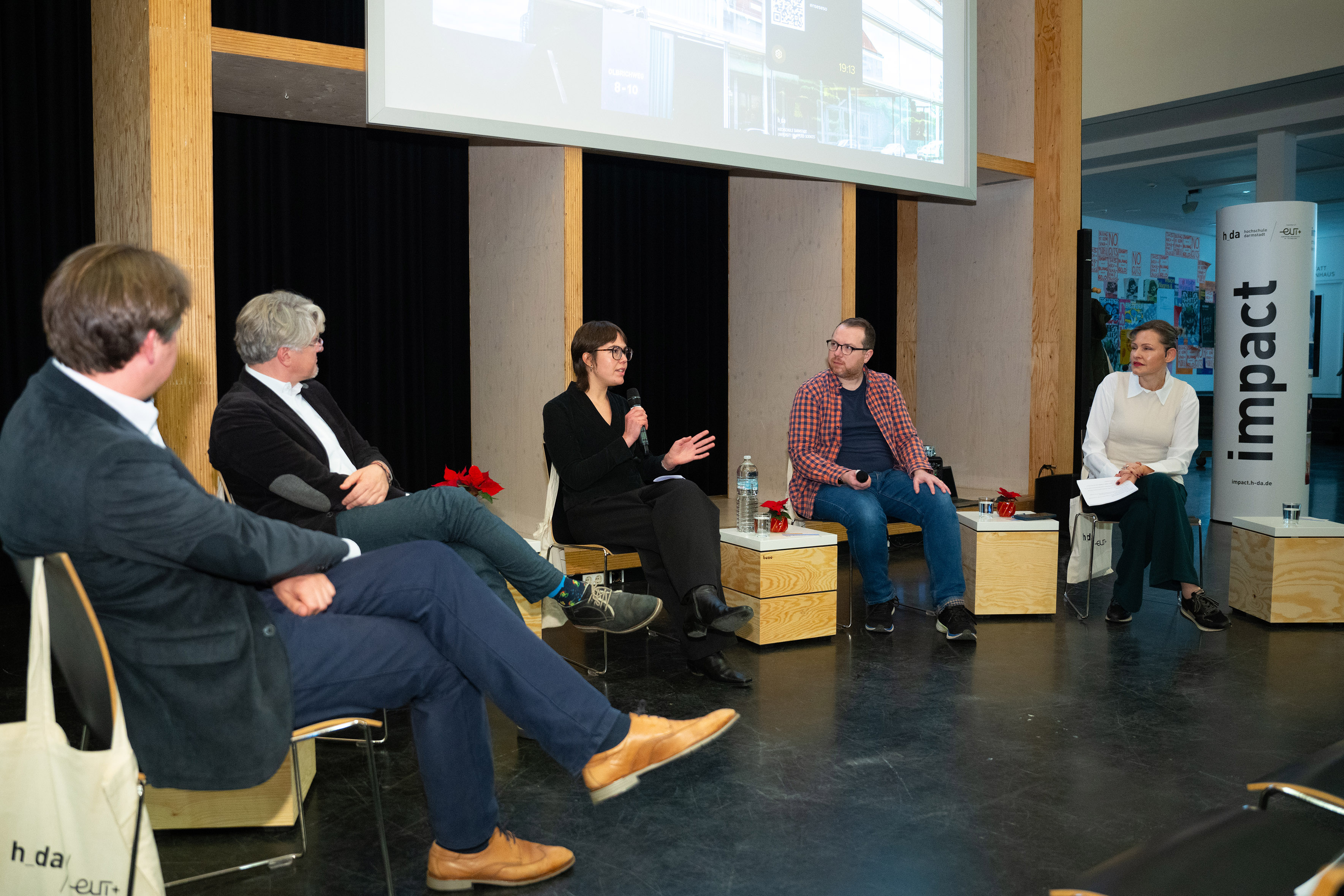
‘Even if it's only a problem in our perception, it's still a problem!’ said moderator Marion Kuchenny at the beginning of the discussion, referring to the relativising research results and contrasting them with the phenomenon of ‘perceived reality’. The loudest voices receive disproportionate attention and visibility, thus dominating the debates. ‘How can we then raise awareness that fake news is only a marginal phenomenon?’ Leonie Heims from the internet portal against conspiracy narratives ‘Der Fabulant’ observes in her work that for many users, an emotional component has come to play alongside the categories of “true” and ‘false’. Namely: ‘Does this news feel good to me?’ That's why they tried using humour to educate people and expose the absurdity of conspiracy myths.
Rademacher pointed to the impact of classic journalistic news factors: ‘Good news alone doesn't work, that's clear.’ But there are good examples of emotional formats such as ARD's theme weeks, which personalise topics and present them in a profound but calm and informative way. Rafael Bujotzek, online journalist and lecturer in the Media Department at h_da, has developed a live fact check for political talk shows with his team. ‘We have a prototype that tracks TV programmes and can show almost in real time when nonsense is being talked.’ Rating: definitely useful. However: ‘It depends on money at the moment.’ They had invested a large amount in development and could not continue to do so to the same extent. And for years, editorial offices had been thinning out rather than improving in terms of personnel and equipment.
Marion Kuchenny lamented the lack of a ‘sensible overall strategy’ in politics. Bujotzek echoed this sentiment: ‘Why are we making ourselves dependent on US providers and don't have a German social media platform?’ Junk would like to see the Chinese and US platforms we use at least regulated and controlled here. ‘Germany would have to say: either there is curation or there is no licence,’ emphasised Rademacher. A political strategy would have to address many issues at once. ‘That would require a phalanx of several players.’ Junk is less convinced by a central strategy, preferring to try things out on a small scale and then roll them out more widely: ‘There is strength in diversity and wildness!’


Have we forgotten how to discuss?
‘We no longer know how to engage in discourse!’ Marion Kuchenny put forward a thesis that opened up the discussion to the audience. She teased those present, saying that we now only exist in ‘digital self-affirmation bubbles’. ‘Wrestling with compromises in a factual, tough but respectful debate – we don't know how to do that anymore!’ True, said one guest from his own experience. He also misses the culture of discussion on the internet. Rarely are objective arguments exchanged in digital comment sections; practically never does anyone admit at the end that they were wrong and acknowledge the stronger argument. ‘Yes, different rules apply online than face to face,’ Leonie Heims conceded. ‘It's tedious to moderate discussions. Nevertheless, we mustn't give up!’
Another guest asked the group for practical suggestions on how social media and smartphones could be integrated into school lessons. Rafael Bujotzek had an idea: in Year 7 or 8, pupils could be taught how to conduct interviews, introduce them, film them and edit them for specific channels. The whole class could then discuss the processes and content. ‘We need to strengthen media literacy – including that of parents!’ agreed Leonie Heims.
‘Digital education for all generations’ emerged as a common desire among all those present that evening. One visitor wanted to know: ‘How do you envisage media education for adults in concrete terms?’ Another listener emphasised: ‘We have too few channels through which education flows back from young people to older people!’ Marion Kuchenny praised such ‘reverse mentoring’, in which younger people coach older people: ‘Digital natives explain to boomers how social media platforms work.’ Digital skills could also be taught in a targeted manner during educational leave. At the end of the h_da dialogue forum, Lars Rademacher aptly summed up what everyone considered necessary in his keynote speech: ‘Intensive and low-threshold media education and source criticism courses for all age groups.’
Contact our Editorial Team
Christina Janssen
Science Editor
University Communications
Tel.: +49.6151.533-60112
Email: christina.janssen@h-da.de
Photography: Markus Schmidt
Further events
Under the motto ‘Shaping Democracy’, h_da 2026 invites you to two further h_da dialogue forums. On 29 January 2026, the theme will be ‘Building Democracy: How Design and Infrastructure Can Connect People’. On 16 April, the topic will be ‘Who gets to decide here? Democracy and social cohesion’.