


Design expedition for democracy
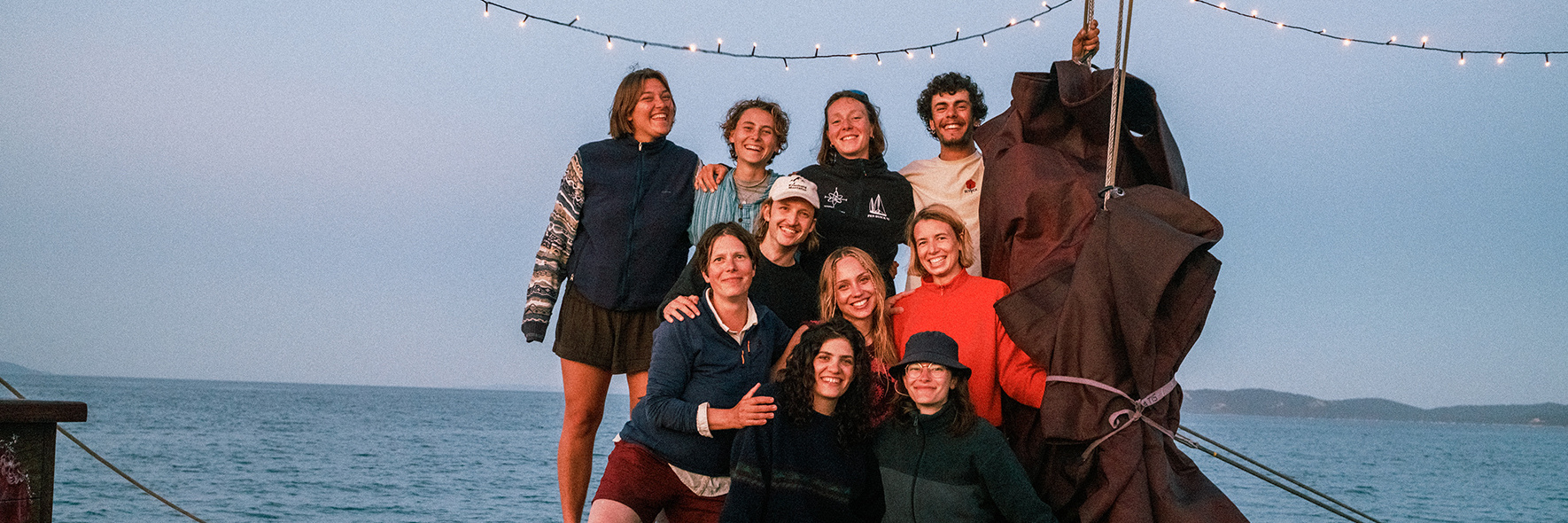
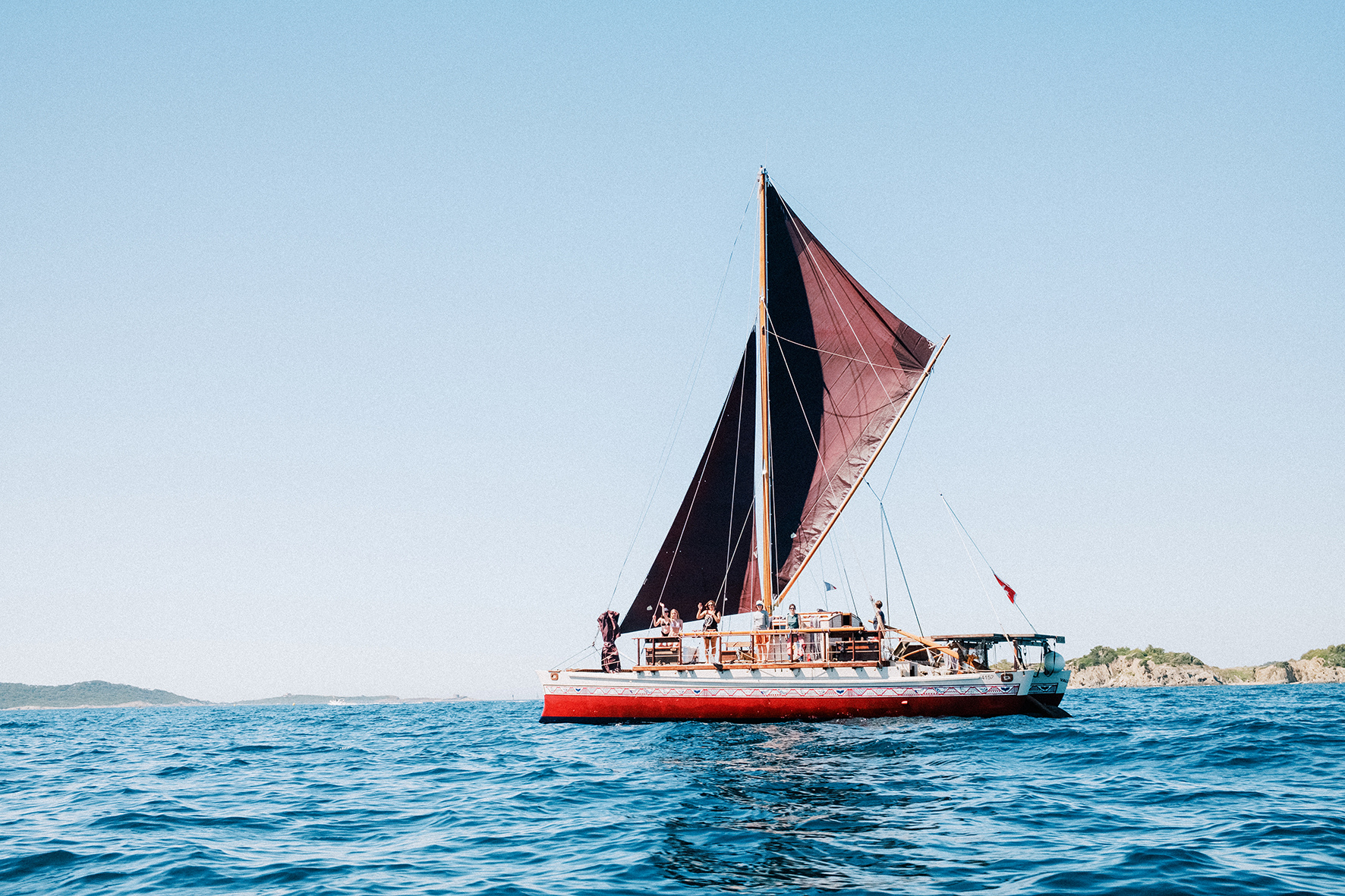
Seven days together at sea: This is what Professor Gesa Foken and five students from the Faculty of Design experienced as part of the project “MEER Demokratie” (“Let’s Sea More Democracy”). Also on board was Josephine Gerhardt from “greenD”, an independent design and sustainability initiative. She organises and runs the annual “Seaside” summer schools. The aim of the design expedition was to further sensitise design students towards sustainable thinking and action as well as towards democratic processes. Their trip began in Hyères near Toulon on the Côte d’Azur in France, where the group boarded a Vaka catamaran, a replica of a sailing vessel once used by Polynesian seafarers – true to the original but ultramodern. The Okeanos Foundation supported the project by financing the boat and three experienced sailors.
By Simon Colin, 23.06.2026
“Are your legs still wobbly?” asks Professor Gesa Foken, looking around the room. The students nod. “When I get up in the morning, I still walk with my arm stretched out in front of me and hunched slightly forwards,” says Paul Abendschein. Like you do automatically on the deck of a ship when you can feel the constant swell and must be ready to catch your balance.
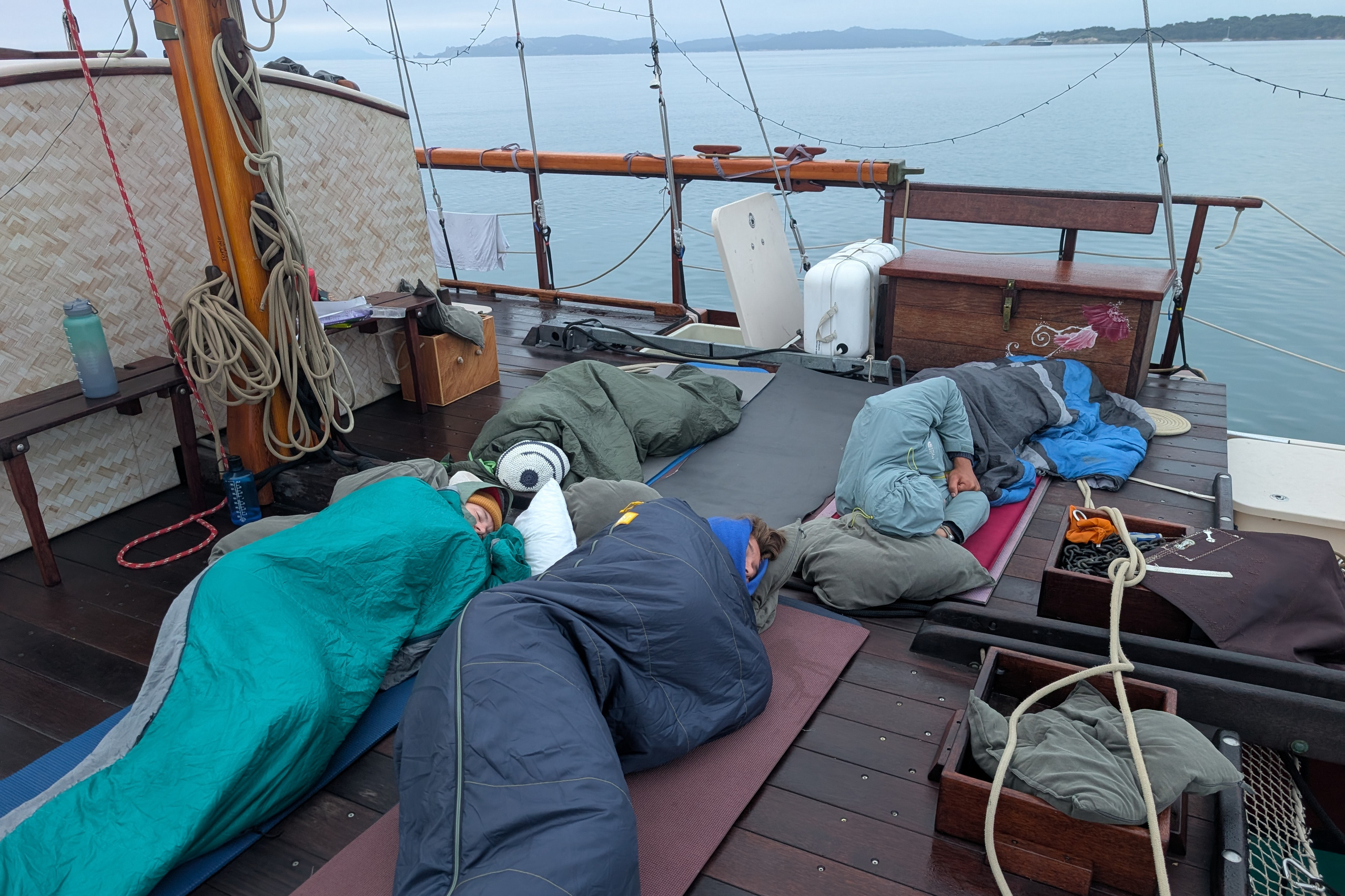
Gesa Foken, a philosopher and Professor of Artistic and Design Education, and her students are meanwhile back on dry land. On the lush green lawn in front of the faculty building on Mathildenhöhe, they recapitulate a week that left its impression on them all. Not only can they still sense the sea swell, but their experiences linger too. And life steered by nature, determined by its rhythm. To the extent that most of the students did not sleep below deck, but under the open sky. “We were woken by the sun,” says student Josephine Benders.
A deceptive idyll
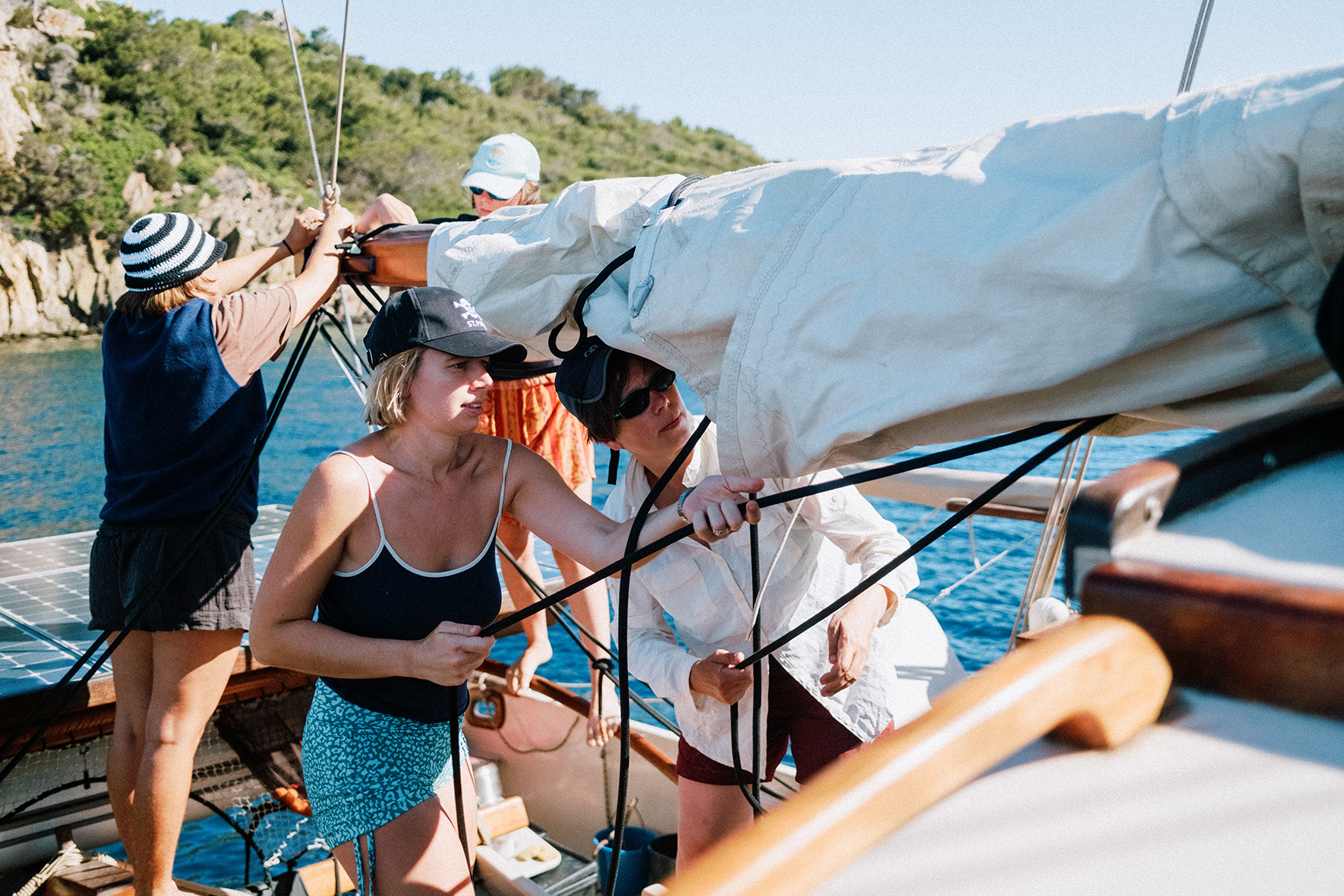
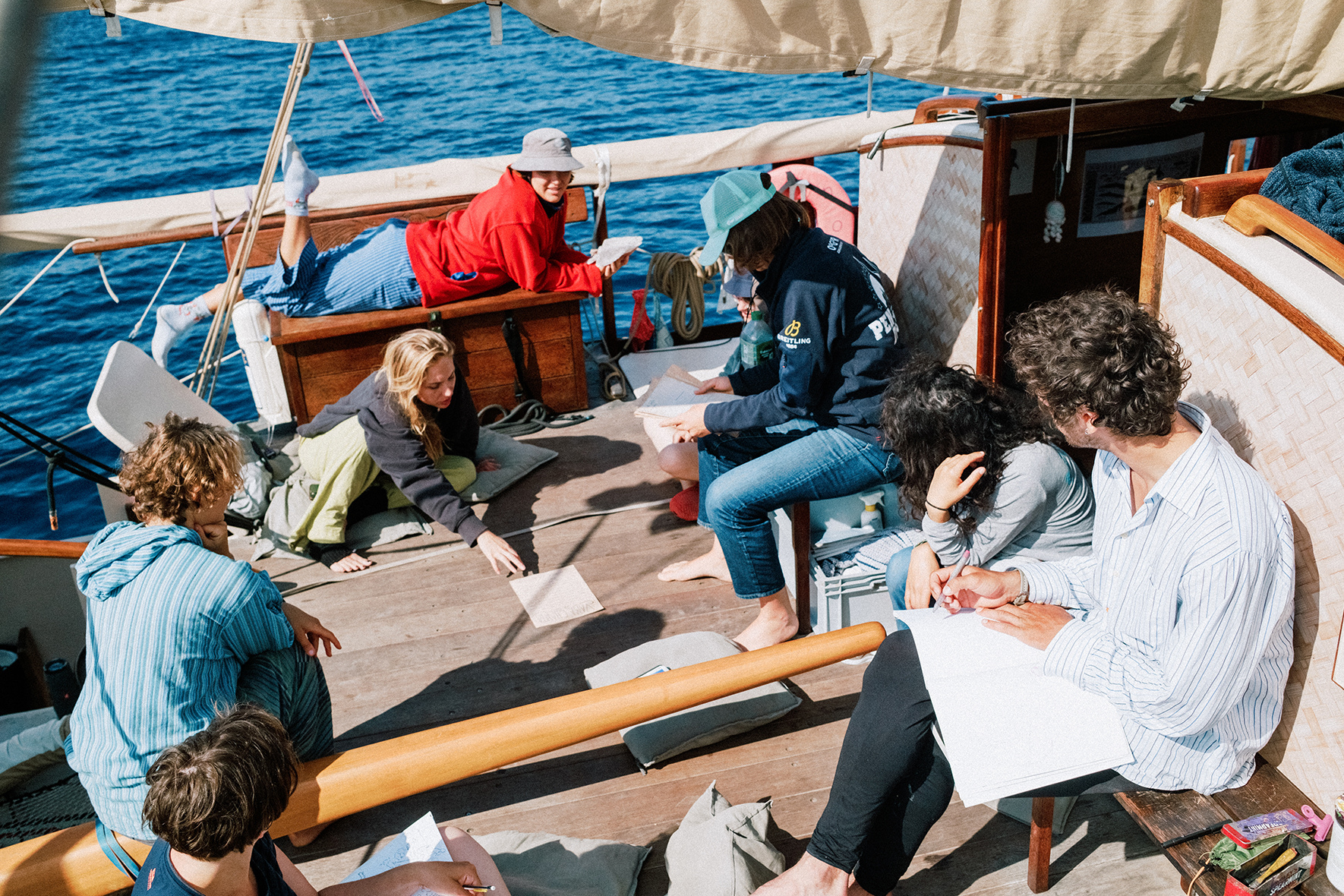
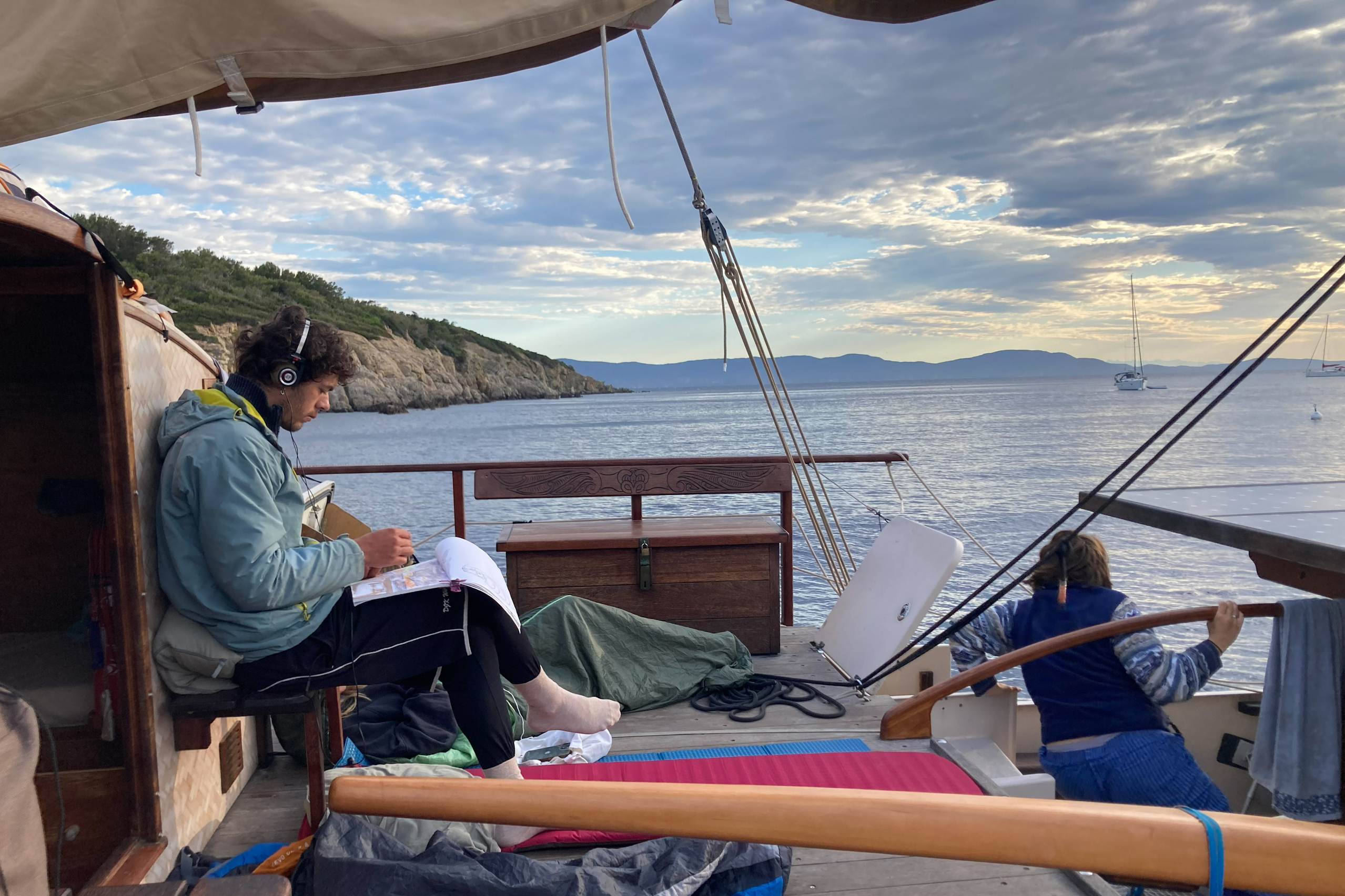
“All our plans each day depended on the sea,” she goes on to explain. Mealtimes, jointly prepared by the students and consciously savoured, and sailing together formed the anchor points. In the hours between, workshops and discussion sessions took place, where the students were able to combine their knowledge of marine ecology and their sailing experiences with aspects of sustainability and democracy. Some of the workshops were run by the crew, who were not only experienced in sailing but also in marine biology and team building. “The crew soon gave us structure and support,” says Professor Gesa Foken.
What left a particular impression on her and the students were the immediate, sometimes very small moments in nature. Student Elias Khater remembers a two-day stay in the National Park of Port-Cros: the waves were high, and the crew agreed to take the students further out to sea once more. “We jumped around on deck in time with the swell and dipped our feet in the water,” he recalls. “It felt a bit like being kids again,” says Gesa Foken, putting the sensation into words.
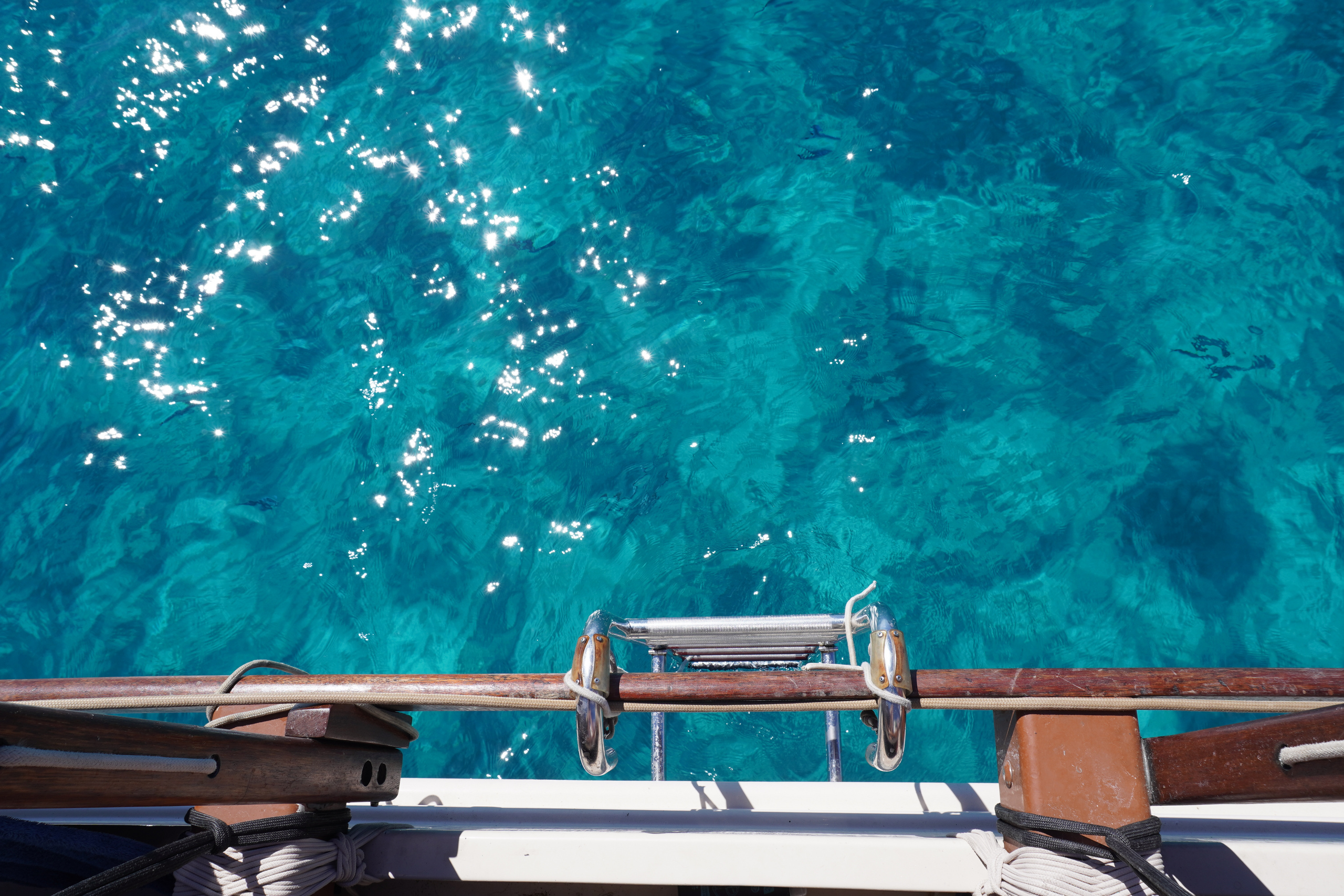
The contrasts, which clearly showed just how omnipresent the effects of environmental destruction are, were very striking. Paul Abendschein mentions the crystal-clear water off the south coast of France. The ideal holiday destination, but also a sign of ecological imbalance. “The paler the seabed, the fewer plants grow there,” he explains.
And then those floating cities – gigantic, brightly lit cruise ships – which the students encountered at night. The catamaran was regularly obliged to evade them. “You could still smell their engine oil kilometres away,” says Gesa Foken. They learnt that the noise from these ships massively disturbs marine life. “And on board you are completely cloistered away from nature,” as Paul Abendschein puts it.
The students also felt like they were living in a parallel world while moored in a bay just outside Saint-Tropez: they themselves on a comparatively spartan catamaran, while all around them decadent luxury yachts blared out music across the entire bay and kept their engines running – to power the air conditioning systems, among other things.
Connection between sustainability and democracy
“In essence, this is also about inequality,” says Paul Abendschein, putting it in a nutshell. After all, only very few – the wealthy and the super-rich – can afford cruises and luxury yachts. Yet in the pursuit of these pastimes, they disrupt or even destroy the ecological and, at the end of the day, the social fabric. From on board, the students were able to observe first-hand the connection between sustainable and democratic dynamics. The students reflected on these experiences in group discussions moderated by Gesa Foken and Josephine Gerhardt, who – together with greenD founder Kurt Friedrich and his team – had already sensitised the students prior to the design expedition and prepared them for what they would experience on board.
In this context, the group itself was a small democratic unit that was intended to function as a community. Clearly defined tasks structured their interactions at sea. “We had to be able to rely on each other,” says Gesa Foken. Josephine Benders adds: “We lived together in a confined space, but there was nevertheless plenty of room for each person’s individual needs.” The students quickly transposed this democratic approach to their understanding of design as well. “Products should be conceptualised in such a way that they accommodate everyone,” believes Paul Abendschein. In his opinion, this not only includes the users but also those who might suffer the effects of production – such as the mining of rare earths, which are needed for the growing electric vehicle sector, among other things.
“To what extent must we all keep pace with technological progress?” says Professor Gesa Foken, posing the final overarching question. Everyone nods. Artificial intelligence, for example, which is still in its infancy, consumes vast amounts of water. The students themselves demonstrated that making small sacrifices can work: while at sea, they took a digital break and had only very limited access to their smartphones.
Bringing everyone on board
Professor Gesa Foken now wants to incorporate her experiences at sea into her future teaching and asks herself: “How can teaching be so effective that it brings everyone on board?” The students, for their part, hope that the community spirit they experienced on board, as well as their increased awareness of the interconnections between everyday life, democracy and, of course, design, can be transposed to society as a whole.
“Here, we want to keep in mind what must ultimately be at the heart of all creative activity: our planet Earth,” says Josephine Gerhardt. “It is the finite and at the same time indispensable foundation of all life – the source of beauty, air, water, food and resources. If design education claims to help shape the future, this reality must be its starting point.”
They now want to build on all this together as well as share their experiences and insights. Supported once again by greenD and Okeanos, they are planning a public dialogue workshop (see infobox) on 15 July at the Museum Angewandte Kunst in Frankfurt in the frame of “World Design Capital Frankfurt RheinMain (WDC)”. The design expedition continues – from the sea to the Main.
“MEER Demokratie”: Social Design On and With the Sea
Public dialogue workshop in the frame of World Design Capital Frankfurt RheinMain
Time and date: 11.00am-8.00pm, Wednesday, 15.07.2026
Venue: Museum Angewandte Kunst, Frankfurt
Registration and further information: https://wdc2026.org/en/events/social-design-auf-und-mit-dem-meer-oder-dialogwerkstatt
Contact our Editorial Team
Christina Janssen
Science Editor
University Communications
Tel.: +49.6151.533-60112
Email: christina.janssen@h-da.de
Translation: Sharon Oranski
Links
Communication Design
Industrial Design
greenD (in German only)