


Mobility Projects
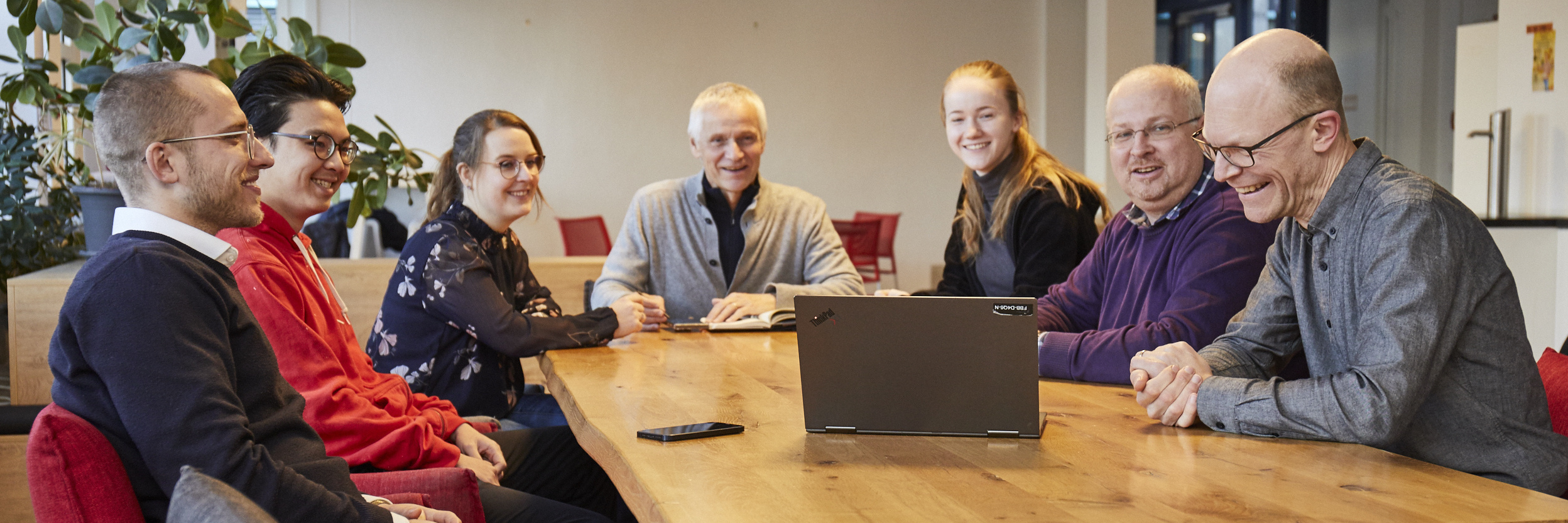
It was an enquiry from FIFA for a traffic survey ahead of the 2005 Confederations Cup that started the ball rolling and led – 20 years ago – to the creation of the Student Project Office for Transport and Mobility (SPV) at Darmstadt University of Applied Sciences (h_da). Since then, the student team at h_da has put a number of successful projects into practice, such as the cycleway from Darmstadt to Frankfurt and urban cable car routes as well as road safety and mobility projects. It has also won numerous awards and was recently even invited to the Federal Chancellery in Berlin.
By Astrid Ludwig, 2.12.2025
Football always attracts attention. When an enquiry from FIFA, the International Federation of Association Football, landed on his desk, Klaus Habermehl, Professor of Civil Engineering at h_da, immediately sprang into action. The Confederations Cup was due to be held in Frankfurt and four other German stadiums in 2005. A year before Germany’s World Cup “Summer’s Tale”, FIFA wanted to subject the stadiums to a stress test and was looking for universities that could conduct a traffic survey. Habermehl agreed and brought his colleague Professor Jürgen Follmann on board along with around 40 students from the Faculty of Civil Engineering. The aim was to examine traffic flow before and after a match at the stadium in Frankfurt, interview visitors and develop a concept for how fans could travel to and from the stadium by car, public transport, on foot or by bike without experiencing major traffic jams and chaos.
Inception of the Student Project Office
Recruiting students was easy, recalls Professor Follmann. “They received FIFA accreditation and were allowed to watch all the matches.” This meant that they not only counted cars or interviewed fans arriving at the stadium but also saw the matches live, of which there were four before the final. The h_da students were given a work contract, “which called for project management and a cost centre,” says Follmann. That was the inception of the Student Project Office for Transport and Mobility (SPV) at h_da. The office provided the necessary framework, and for those responsible it was not “just for fun”. “We took it very seriously. There was only a year to go before the World Cup,” Follmann remembers. From the outset, they urged FIFA to take public transport and cyclists into account too. “That has always been our recurring theme,” stresses transport expert Follmann.


The h_da team not only examined how fans travelled to and from the stadium and whether there were enough buses and trains or parking spaces for bicycles and cars. Together with the participating universities in Berlin, Bochum, Braunschweig and Munich, they also developed a methodology for the traffic survey. And they suggested improvements. Leaving the stadium after a match proved to be the sticking point. “That’s why we suggested to FIFA that they stagger the number of fans entering and leaving the stadium and offer a supporting programme before and after the matches. It was also necessary to make sure that trains ran late into the night,” said Follmann. Advice that was taken.
International touch
That started the ball rolling, and the first remit led to others. By chance, the team came into contact during the Confederations Cup with South African FIFA officials who were to host the 2010 World Cup in their country. “The stadium in Frankfurt is similar to that in Port Elizabeth,” explains Professor Follmann, which was why the project office was asked if it could conduct a similar traffic survey for South Africa. Follmann and Klaus Habermehl, who has meanwhile passed away, were invited to Cape Town, where the local newspaper greeted them with the headline “Transport gurus fly in from Germany”, which he still finds amusing today. From the outset, the team had an international touch and contacts with partner universities and cities in China (Tongji University in Shanghai), Estonia (Tallinn), Georgia (Tbilisi) and – when this was still possible – Russia (Ulyanovsk). “We were already very advanced even back then as far as road safety, street planning, mobility and cycleways are concerned,” stresses Follmann, who today is also the university’s Mobility Officer.

Thanks to the football project, the h_da team became well known – in Darmstadt, the Rhine-Main region and nationwide. For example, a study on the mobility behaviour of schoolchildren in Offenbach followed. The students asked schoolchildren from Year 5 upwards how they got to and from school, whether they encountered any problems along the way and, if so, which ones, and then evaluated around 19,000 questionnaires. The result was a mobility concept for schools in Offenbach for the period from 2008 to 2012. In 2013, a project with the Claus von Stauffenberg School in Rodgau led to the introduction of a public transport ticket for upper school students, the precursor to Hesse’s “School Travel Pass”. Mark-Simon Krause, a research associate in the project office, explains how the students visited 500 pupils in the classroom and encouraged them to keep a travel log. The students then evaluated 40,000 journeys. “Everything was noted down by hand, and then the data was entered into the computer.” Follmann says that the students were treated to interesting field trips as a reward for their hard work, which was also acknowledged in 2010 and 2024 when the team won the Hessian University Prize for Excellence in Teaching. Topical issues and projects are always incorporated into teaching, as Professor Follmann is keen to highlight.
Hands-on experience
Keep your finger on the pulse, ask the people concerned and interact with the public – that’s the team’s guiding principle. “Real-world laboratories” and “experimental spaces” belong to everyday working practice at the project office. To visualise the size of a roundabout or the length of a cycleway for local residents, users or decision-makers in politics and administration, on occasion the team lays out large, round tarpaulins or rolls of red carpet on the road. Laura Kehrer, at that time a student and now a research associate at the project office, sat in a wheelchair to understand why the residents of a retirement home in Heusenstamm were reluctant to leave it. How can you make elderly people more mobile? By talking to them over tea and biscuits to learn where the shoe pinches. The students accompanied the elderly residents around the town on foot to the places of their youth. “Many paths were not accessible, there were no benches for them to sit down and no toilets,” says Kehrer. The town responded by moving parking bays onto the road and installing benches, and shops opened their toilets to senior citizens. “The students have done pioneering work,” says Follmann.

“The projects threw us in at the deep end,” recalls Svenja Weber with a smile. She worked as a student at the project office, recently won second place in the prestigious award of the German Road Safety Council for her Master’s thesis and is now responsible for cycleway planning at Hessen Mobil. As a student in the project office, Weber was involved in the planning workshop for an important rail transport project of the Federal Government, the State of Hesse and local authorities, called Regionaltangente West, which is to run from Dreieich via Neu-Isenburg and the airport to Frankfurt and the Taunus mountains. “I had to present our results on the stage in front of hundreds of people,” she remembers to this day. “As students, we were always at the forefront,” says Mark-Simon Krause. Deliberately so. “Students must be able to present their ideas in public and engage in discussion,” says Professor Follmann.
Recognised experts for bicycle traffic
The Student Project Office for Transport and Mobility has achieved recognition, not least in bicycle traffic planning. It accompanied the introduction of red cycle lanes and cycle streets in Seligenstadt, Heusenstamm, Groß-Umstadt, Neu-Isenburg, Offenbach and Darmstadt. “We have shown how it can be done,” says Follmann. Bicycle traffic in Darmstadt has since increased from 18 to almost 30 percent. “A huge jump.” The highly acclaimed cycleway from Darmstadt to Frankfurt stems from an idea by two h_da students. Today, seven municipalities are involved, and eleven of the 35 kilometres from Darmstadt-Arheilgen to Langen have been completed. Up to 3,000 people use the cycleway every day as well as at night, thanks to solar-powered lighting. “It is a real asset for the region and would not have been possible without the work of the project office,” says Follmann, who in 2019 was awarded the university’s Science Prize. A second connection is being planned in the district of Offenbach and another from Aschaffenburg to Hanau. Here, too, the project office is involved.

Photo: h_da / Markus Schmidt
The traffic experiment initiated by the project office in collaboration with the town of Heusenstamm in 2023 is attracting nationwide attention. The main carriageway for cars in a residential area is being reduced to a single lane with protected cycle lanes on both sides – which cars are allowed to use to overtake – to replace two pavements and cycle paths on the side of the road that are currently too narrow. As a result, cyclists now feel safer, while car drivers keep their distance and do not overtake as often. Pedestrians also feel safer because almost 90 percent of cyclists now use the road. The experiment is so successful that Hesse’s Ministry of Transport has applied to the Federal Ministry of Transport for a corresponding amendment to the road traffic regulations, and the team was recently even invited to the Federal Chancellery in Berlin. Laura Kehrer was tasked with compiling further results and experiences from neighbouring countries and then presenting them again in the Federal Chancellery.
Krause and Kehrer have also made a name for themselves as road safety auditors. On behalf of the state, since 2020 they have audited traffic planning in Hessian municipalities that receive public funding. They work with Professor Follmann to assess these projects in terms of road safety and give their expert opinion. To this end, the team completed further training at the Federal Highway and Transport Research Institute (BAST) and as a project office is now also authorised to train auditors itself. This is, in Follmann’s opinion, affirmation of its excellent reputation. There are only three training centres in Germany – h_da is the only university of applied sciences, alongside the universities of Wuppertal and Weimar, allowed to use this title. “We finance ourselves through our own project acquisition,” Mark-Simon Krause is keen to underline.
Urban cable cars and other futuristic visions
The h_da researchers are also experts when it comes to floating away at lofty heights from traffic jams and congested roads. For years, Follmann, who finds unusual ideas and innovations inspiring, has been promoting urban cable cars as a future means of sustainable transport and has planned numerous projects with his students, some of which he has also supervised. For the 2024 Federal Horticultural Show in Mannheim, for example, his team and the project office assessed the cable car in terms of sustainability compared to alternative means of public transport. They are currently calculating the cost-benefit factor of a cable car route from Kaiserlei, a suburb of Offenbach, to the skating rink in Frankfurt. The project is part of the Rhine-Main region’s designation as “World Design Capital 2026”. This title is awarded every two years by the “World Design Organization” (WDO) based in Canada and acknowledges cities or regions for design-oriented innovations and model projects. Because h_da is a leader in the planning of urban cable cars, “we even have students from ETH Zurich and KIT Karlsruhe coming to us,” Follmann is pleased to report.

With this 20-year success story under their belt, those involved have every reason to be confident, and they have concrete plans for the future. “We are an innovation hub at h_da and want to share our knowledge,” say Follmann, Krause and Kehrer. Either in the form of an h_da institute or as an independent start-up. Discussions are underway. They also have suitable premises in mind – HUB31 Technologie- und Gründerzentrum Darmstadt, the technology and start-up centre in the west of the city.
Contact our Editorial Team
Christina Janssen
Science Editor
University Communications
Tel.: +49.6151.533-60112
Email: christina.janssen@h-da.de
Translation: Sharon Oranski

Links
Student Project Office for Transport and Mobility (in German only)
Professor Jürgen Follmann’s website (in German only)