


Mollerstadt
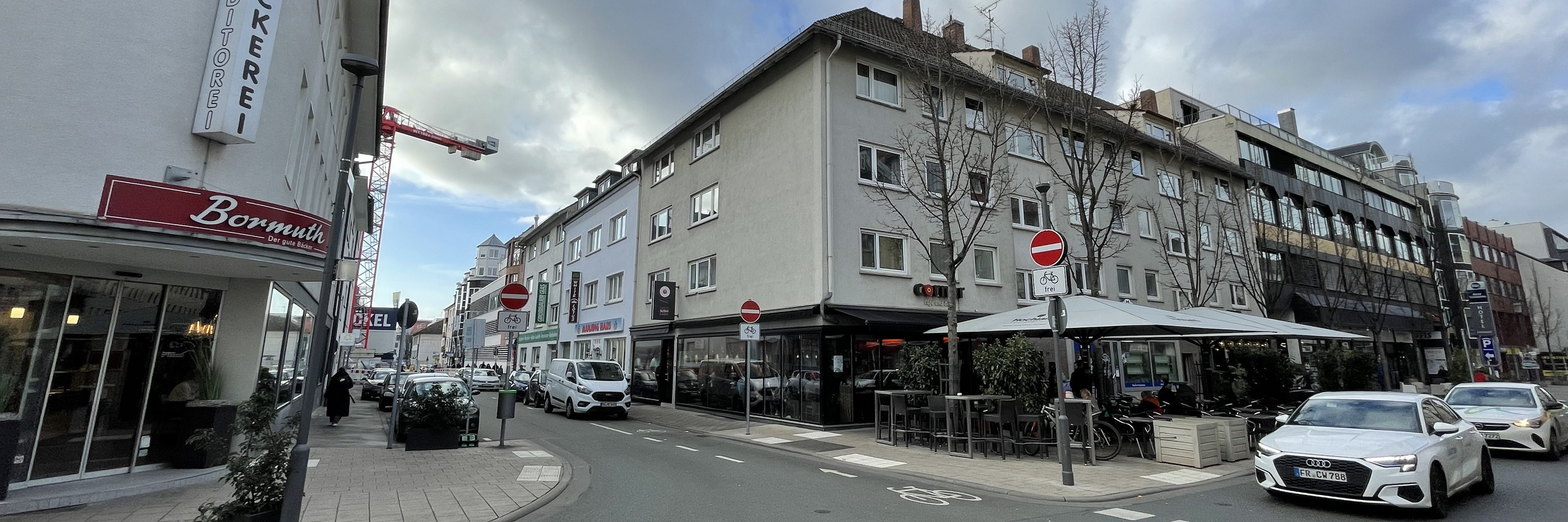
Together with more than 20 experts, urban planning professor Astrid Schmeing has analyzed the potentials and pitfalls of future-oriented urban development using the example of Darmstadt's Mollerstadt. The results are sobering in many places. In the impact interview, she explains why it is so difficult to implement what is necessary when it comes to mobility and greening. She also points out that the climate protection targets cannot be achieved in view of the many braking factors and obstacles.
Interview: Alexandra Welsch, 14.12.2023
impact: Ms. Schmeing, you live in the airy, green Woogsviertel district, would you also want to live in the densely built-up Mollerstadt?
Prof. Astrid Schmeing: One pro would be the centrality, that you have everything around the corner and urban life. A central counterpoint would be the lack of greenery and the poor quality of the building fabric.
impact: Using this Darmstadt city quarter as an example, you have just presented a comprehensive analysis in book form, which examines key issues of sustainable urban development in an interdisciplinary collaboration with more than twenty experts from science and practice. What does sustainable mean in this context?
Schmeing: We have based this on the concept of the "city of short distances". The core idea is that everything is mixed-function and close together and that you don't have to travel by car. Other forms of mobility are added. However, it is only truly sustainable if other dimensions are also considered, such as the conversion of existing buildings instead of replacement buildings and greening.
impact: What are the potentials and pitfalls in the Moller city, for example in terms of mobility?
Schmeing: We looked at Grafenstrasse in the book because a redevelopment process had already been carried out there. Parking spaces were removed, but restaurants, pedestrians and cyclists were given more space. The city of Darmstadt considers Grafenstraße to be a very successful example of urban development. One can agree in that it has an urban character and less car traffic. At the same time, one must qualify that not so many parking spaces have been eliminated that it would have an effect on the neighborhood. Mollerstadt has a lot of commuters and they bring cars with them. Many parking spaces in the courtyards are rented out to external parties. And the city has no access to private space. This is a catch that runs through the issue of sustainable urban development to some extent: there is little public space and therefore little room for maneuver for the city.


impact: And what about the buildings?
Schmeing: The houses in Mollerstadt were built quickly after the destruction of the Second World War and have never been of a good standard. In view of the fact that we have to saveCO2, the building fabric is poor. Energy emissions there are 30 or 40 percent higher than in more recent, well-insulated buildings. So there is a lot to do.
impact: Here, too, you analyze private property as a key lever for sustainable urban development and at the same time see the biggest obstacles, in what way?
Schmeing: The existing buildings are protected; I can't force the owners to renovate. It's also not easy for many owners to modernize. These are older people, for example, who can no longer get loans, or communities of owners who can't come to an agreement. They are not geared towards renovation. And they've had little reason to do so because they've still been able to increase their returns - regardless of whether they do anything or not.
impact: There is also a braking effect when it comes to greening, isn't there?
Schmeing: Alongside mobility, greenery is the area where little is being implemented. Cities want to green, but have very little public space available. Greenery was also not sufficiently implemented in the redevelopment of Grafenstrasse. The density of cables in the ground, for example, is so high that hardly any trees could be placed between them. But these densely built-up, sealed urban spaces act like a heat island with up to 10 degrees Celsius more in summer than in the surrounding area. This can have serious consequences. France, for example, had around 10,000 heat-related deaths in the summer of 2023. Greenery is an important antidote to this, for example in the form of green façades. But that brings us back to the owners, who see little reason to do so. Although a funding program was offered in the Moller city, it was not requested. The city would have to force more greenery here.
impact: And what about the energy transition?
Schmeing: Switching to non-fossil energy sources is a challenge. For geothermal energy, for example, you have to drill deep into the ground and you need space, which you don't have in a densely built-up area. Heat pumps are also not easy to use because they are not as effective in poorly insulated buildings. Insulating buildings is a key modernization goal, but for many this is a question of cost. In the book contribution on the subject of energy, district heating from Darmstadt's waste-to-energy plant was proposed as a sustainable supply, but was discussed heterogeneously by the experts involved. This is because heating with waste incineration is greenhouse gas intensive. However, we will probably continue to produce so much waste for several decades that the plant will remain in operation. We are thus making our way from one bridging technology to the next. And we are not making the leap to truly sustainable solutions within our growth-oriented economic system.

impact: Why do you explicitly focus on consumption here?
Schmeing: The entire consumer sector is very much anchored in the Moller city and is not sustainable at all. There is a shift towards online retail, which is associated with more deliveries and waste production. Both the production of consumer goods and delivery areCO2-intensive.
impact: This is not the only reason why you are calling for alternatives to consumption.
Schmeing: Particularly with regard to the residential function and neighborhood development in the district, I need recreational areas that are not consumer-oriented. The only square in the district is in front of the town hall in Grafenstrasse, which should be turned into a green square as part of the redevelopment of Grafenstrasse. However, there is a large tank underneath and a few disabled parking spaces were also needed - and suddenly it has become neither a green nor a neighborhood square. There are quite a lot of recreational areas in the surrounding area due to the restaurants, but no collective "free spaces".
impact: Despite all the potential of the urban city quarter focused on in the book, between "implementation deficits" and "resistance to change", she ultimately comes to the conclusion that none of this is enough to achieve the climate protection goals. The team of authors calls on politicians to take a clear stance. This is often postulated, but not implemented to the necessary extent. Why is that?
Schmeing: The policy is not stringent and contradicts itself. The regulations are often not yet aligned with the latest findings on sustainable development. At some point, however, it ends with the people, the owners, the users, who also have to adapt. And at the moment, it has to be said that the majority don't want to, they don't want to bear the "impositions". This was also evident, for example, with the Heating Act, where there was a great deal of protest.
impact: Should politicians still regulate more, prescribe more?
Schmeing: This view is widespread in green politics, but I see it a little differently. As an architect, I come from a discipline that designs. You try to solve integral problems and create opportunities. And I believe that this helps more than imposing bans. One example is parking space management: parking is regulated, but people see enough reasons to keep their cars anyway and therefore also the sealed parking space. The alternatives are often still too poor. It often takes twice or three times as long to get around by public transport, for example, and rental cars are not yet available close enough. I believe that new solutions need to be designed as complete packages. People are willing to accept feasible solutions.