


Science Picnic 2026
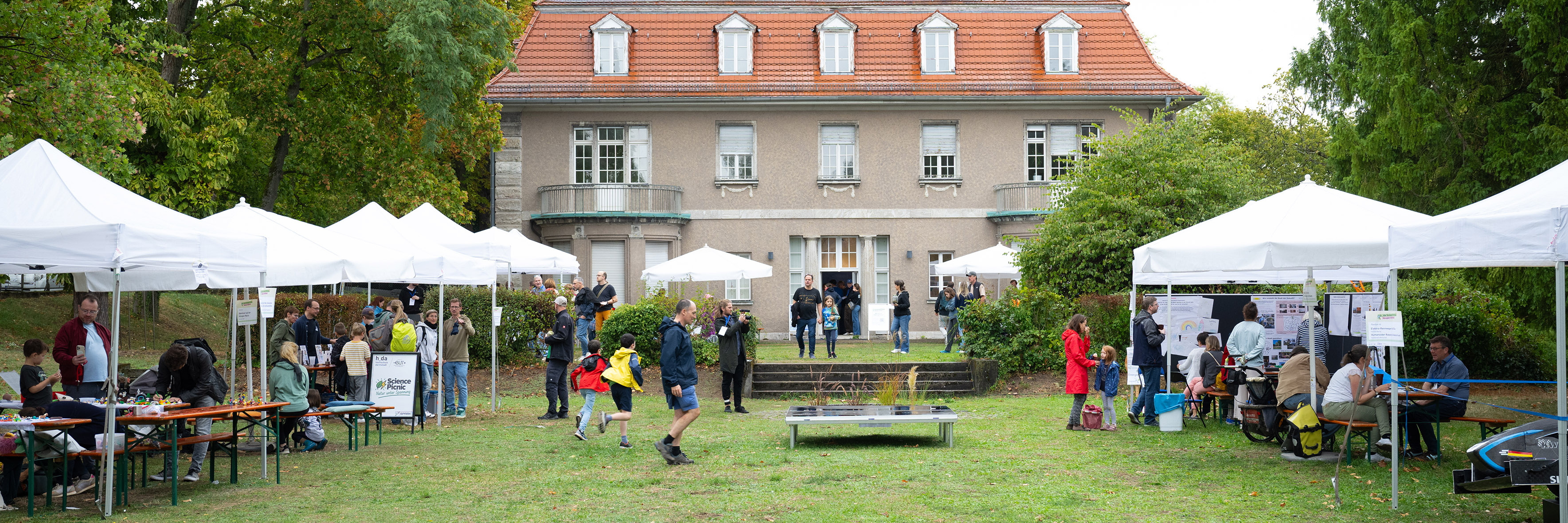
The villa – and the area around it – was teeming with people. On World Children’s Day, science proved to be anything but dry – and that was by no means down to the rain alone. The first h_da Science Picnic attracted more than 200 visitors to the Mathildenhöhe on 20 September. From 2 pm to 6 pm, the Designhaus Darmstadt and its garden were as busy as a beehive. Parents and children came and went – and usually stayed for a few hours in between.
By Daniel Timme, 21.9.2026
Just in time for the lecture to begin, around 40 listeners have gathered in the hall. The regular seats are taken, and the cushions on the floor are in high demand. The lecturer asks for silence. Everyday university life? Not a chance. Those sitting here and listening aren’t exactly completing their undergraduate studies; they’re primary school pupils. It’s only the parents who have any experience of university life. Prof. Dr Sven Linow is giving a children’s lecture on heat protection in schools. “Normally, a lecture lasts two full school lessons,” he explains by way of introduction. “Today, I’ll try to cover it in 15 minutes.” Linow keeps his word. Afterwards, he spends another quarter of an hour answering questions from his young audience.
The children’s reading session thus reflects the programme as a whole: whilst there is teaching, explanation and demonstration, there is also plenty of scope for the children’s own thoughts and ideas. As a result, the young audience is unlikely to get bored any time soon. There are hands-on experiments, opportunities for painting and drawing, building, crafting and creating, a treasure hunt and a quiz.


Overwhelming internal response
The event was organised and coordinated by a team from the Service Centre Research and Transfer (SFT) and the Media Faculty at h_da. “We came up with the idea for the format and gauged the response internally via E-mail,” recalls Iris Rubinich, Transfer Officer at the SFT. “Within just a few weeks, a huge number of faculties got in touch with brilliant ideas and agreed to take part. It was overwhelming!”
This commitment is reflected in the diverse programme on offer at the Science Picnic. Professors, lecturers and students from nine faculties, as well as other initiatives and institutions at h_da, present small, accessible insights into their scientific work for guests to experience first-hand. The following faculties and centres are represented with their projects and facilities: Civil and Environmental Engineering, Chemistry and Biotechnology, Electrical Engineering and Information Technology, Social Sciences, Design, Computer Science, Mechanical Engineering and Plastics Technology, Media and Darmstadt Business School, as well as the Centre of Excellence for Sustainable Development (KNE). The event is also made possible by sponsorship from Merck KGaA, Sparkasse Darmstadt and Dieburg.
The h_da’s first science picnic has been a great success. And yet the weather is hardly ideal for a picnic: it starts to rain shortly after it begins. But whether it’s just drizzling or pouring down, the young science enthusiasts couldn’t care less. The children try things out, watch demonstrations and listen to explanations, ask clever, original questions and come up with creative suggestions. Armed with pen and paper, they set off on a biodiversity treasure hunt in the garden, finding, counting and identifying plants, or eagerly working on the science quiz.
In the Designhaus and the pavilions in the garden, children can experiment with pipettes and test tubes whilst learning about photosynthesis or water treatment. Want to build the city of the future or design your favourite place to beat the heat? LEGO bricks, modelling clay and coloured pencils are all provided. SPARK MakerLab’s ‘Sense the Nature’ offers experiments with sensors and electronics. And a few metres further on, another activity combines hardware and software: here, the kids can programme a LEGO SmartTrain and get it moving.


Mini rainforests to go
“The 100 preserving jars we brought with us were snapped up in no time,” says Mateo Brecic, who launched “Modolino” with Louis Rittersberger just under a year ago. Through their DIY experiments, the two young men from Darmstadt now reach tens of thousands of parents and children via social media. The project they’ve brought along today: bottle gardens. Where gherkins or morello cherries were floating just a short while ago, mini rainforests are now growing: the children design their own bottle gardens, which they can then continue to nurture, tend and observe at home.
“I hardly notice what’s on offer in the pavilions next door because I’m constantly besieged,” says Jennifer Rink, the founder of “Tapari”, with a laugh. The younger visitors are fascinated as they try out her interactive play mat – an audio adventure about a dragon, the course of which the children can control themselves. These more laid-back activities are also proving popular. Inside the quiet room, children and parents are sitting or lying down, relaxing whilst listening to an audio and video installation created by a media student. One floor up, a humanoid robot and a robot dog are being remotely controlled as they walk through a room. Many children are marvelling and laughing – others are a little spooked and prefer to explore what there is to discover down the stairs.
Enthusiasm on both sides of the table
“Everyone is beaming and clearly enjoying themselves,” observes Prof. Dr Nicole Saenger, Vice-President for Research, Knowledge Transfer and Sustainable Development at h_da. With a smile, she adds: “I get the impression that the staff behind the tables are having at least as much fun as the children and their parents in front of them.” The enthusiasm seems to be shared equally. Most of the more than 200 guests, young and old, who make their way to the Designhaus during the four-hour event, stay a little longer. Many parents are grateful for the coffee in such dreary weather, and by around 5 pm the cake buffet has been completely polished off.
By the end of the Science Picnic, the noticeboard of the ‘Black Box’ – the stand for the hands-on and dialogue activity – is covered in colourful notes. On these, children have sketched and described their own ideas. Anything is possible there. Rolling beds take sleepy children to school, moving houses transport people to the seaside; sweets are healthy, chewing gum replaces brushing your teeth, and mobile wind turbines automatically head wherever the wind is blowing. It seems that an understanding of many of the challenges we face is already there. There is no shortage of innovative solutions. The young scientists will work out the details themselves in a few years’ time.
Contact our Editorial Team
Christina Janssen
Science Editor
University Communications
Tel.: +49.6151.533-60112
Email: christina.janssen@h-da.de
Photography: Markus Schmidt
Full programme
The full programme for the 1st h_da Science Picnic on 20 September 2026 is available here (DE): https://h-da.de/transfer/science-picnic.