


Spring School for Design Darmstadt
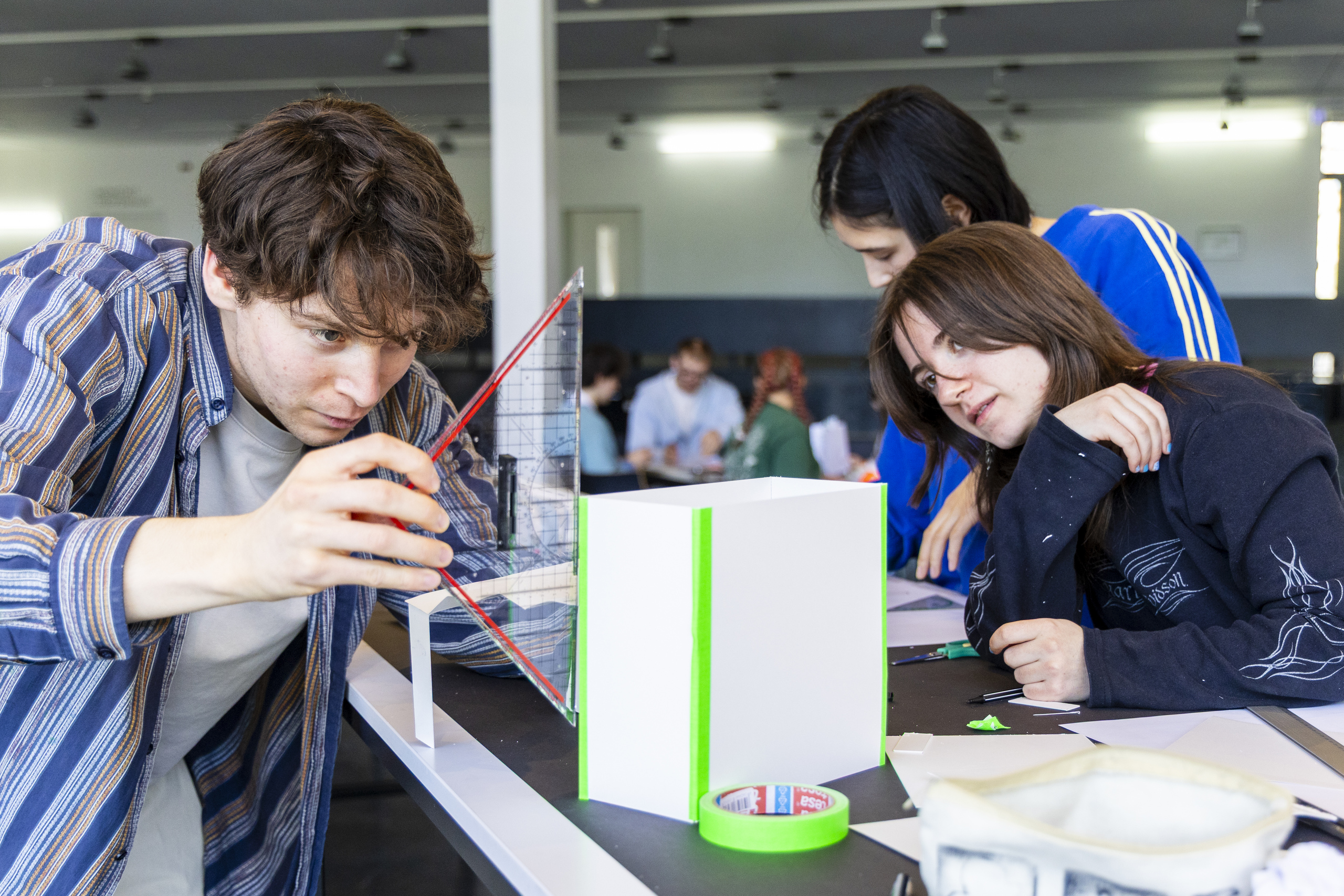
Is a design degree right for me? The ‘identify’ spring school at the Faculty of Design at h_da on Mathildenhöhe offers an opportunity to find out. Young people interested in design get to explore their creativity here in a workshop lasting several days. In the process, they also get insight into the faculty’s laboratories, workshops and studios, as well as the Industrial Design and Communication Design degree programmes. impact was there at the latest spring school workshop.
By Simon Colin, 15 April 2026
Pens dart nimbly across the paper. Lines take shape: rectangles and grids, figures, objects and symbols. Deeply focused, the young people give free rein to their creative intentions. The journey is the destination. ‘Transformation’ is the keyword that spring school director Prof. Sabine Winkler has given the participants for today. And with this in mind, they are now to create something: first on paper, then as a model.
“The actual design process begins with thinking and experimenting,” says Sabine Winkler. She therefore gives the spring school participants plenty of time to approach a topic. “We want to introduce them here to creative thinking, which is a mixture of abstract and very concrete approaches.” The motto of this year’s workshop is “Layers/Levels/Dimensions”.
3D design from paper
For the young people, abstract thinking in particular is still new. “At the start, we were still thinking very realistically and, when we heard the word ‘layers’, we initially pictured an onion,” explains Luciana. “But we’re now moving more and more from the obvious to the free.” Gilles feels the same way. He stands at one of the work tables and places a paper construction on his arm that resembles scale armour.


“When we first considered the keyword ‘transformation’, we thought that people, too, consist of different layers,” he explains. “And the better we get to know a person, the more we penetrate their layers.” At some point, the idea of a protective layer occurred to them, and so they designed a kind of samurai armour out of paper. “Here, we’re learning not to strive for the simple, but to go deeper,” Gilles sums it up.
Amelie, Roja and Valentin feel the same way. They sketch various lines onto paper, arrange and group them, gradually creating a sort of grid pattern. “We’re currently thinking about how to turn this into a 3D object,” explains Amelie. They tear out scraps of paper, fold, layer and position them until they’ve found a structure that can be flexibly compressed and stretched. This eventually results in the first small paper design prototype of a flexible, slatted, fan-like table that can be folded away to save space. Transformation achieved.
Screen printing on T-shirts
One floor below, a few participants are busy in Ericson Krüger’s screen printing workshop. They are standing around a table piled high with countless screen-printed designs, brimming with a wealth of shapes and colours. The motifs were designed by students who are introduced to screen printing at the start of their studies and begin by creating artistic drawings in introductory courses. These are then mounted onto a screen and exposed.

Ericson Krüger stands in front of a huge apparatus reminiscent of a large metal window: the exposure table. As an example, he takes a screen from one of the numerous cupboards, positions the screen and drawing on the exposure table and then demonstrates how both are placed in a vacuum. The screen is finally washed in the exposure tray and then dried. Now it’s ready for printing. On T-shirts, for example. Ericson Krüger shows how the shirts are stretched out and the ink is then applied by hand. “I like how freely you can work with screen printing,” says Jakob, pointing to his T-shirt. “This is screen printing too.” He has already learnt about and tried out the technique at his school.
Touching and understanding products
Many spring school participants enjoy the direct insight into the workshops and laboratories, and thus also into the application-oriented and interdisciplinary design degree programme at h_da. Workshop manager David Behre guides the young people through the rooms and past the numerous machines. “Here in the workshop, design models and prototypes are produced,” he explains. “What makes us special is that the students still work on the machines themselves. When you touch a product, you understand it much better.”
The “Human Factors Lab” is also all about understanding and grasping concepts. Specifically, it focuses on the design and development of products, systems, digital technologies and applications, and how people use them. The lab explores how design can capture and analyse information about human behaviour, human capabilities and barriers. As part of the spring school, participants also get an insight into this laboratory.
All of this helps participants to visualise a design degree much more clearly. “We’ve practised thinking abstractly here and developing our own ideas from that,” says Marlene, for example. “With abstract thinking, you have plenty of scope for interpretation,” which Robin particularly likes. At the end of the spring school, all participants receive a certificate, and the work produced is exhibited in the foyer of the Faculty of Design. Around one in four participants then goes on to study industrial design or communication design at Mathildenhöhe. This is borne out by experience from previous spring schools, says Prof. Sabine Winkler. The workshop thus not only helps with abstract thinking, but also provides concrete guidance when it comes to choosing a degree programme.
Contact the h_da Academic Editorial Team
Christina Janssen
Science Editor
University Communications
Tel.: +49.6151.533-60112
Email: christina.janssen@h-da.de
Photography: Samira Schulz
Information on the degree programmes

Degree programme website Industrial Design
Degree programm website Communication Design