


Star Trek Event at Darmstadt University of Applied Sciences
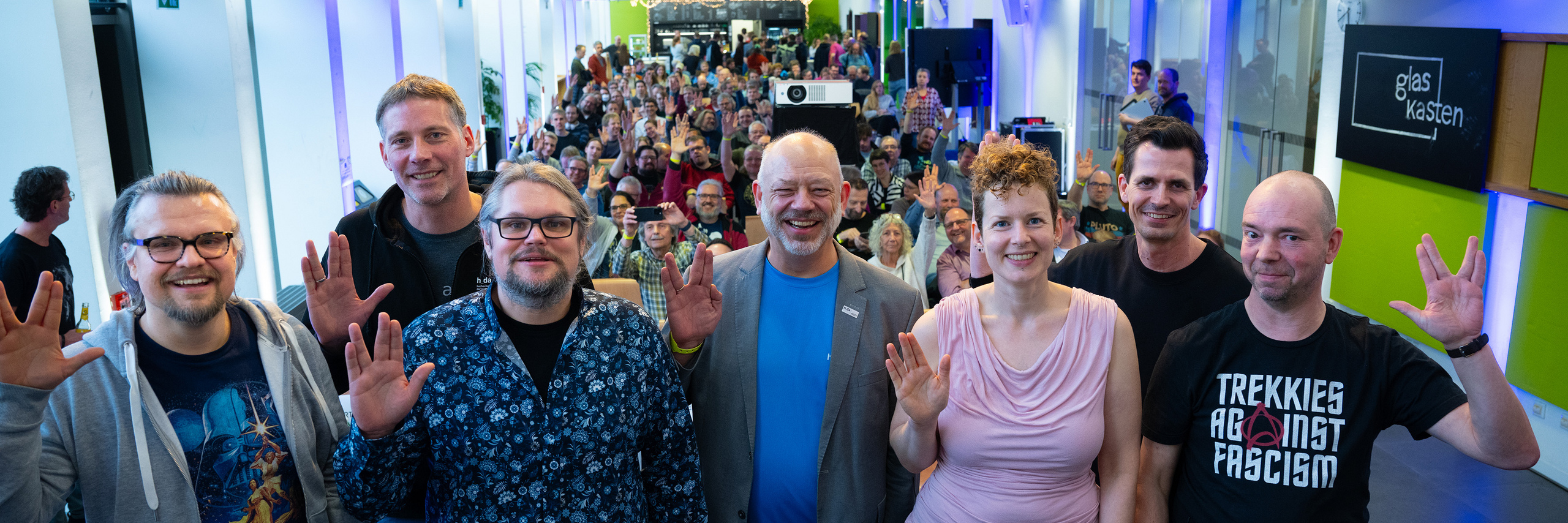
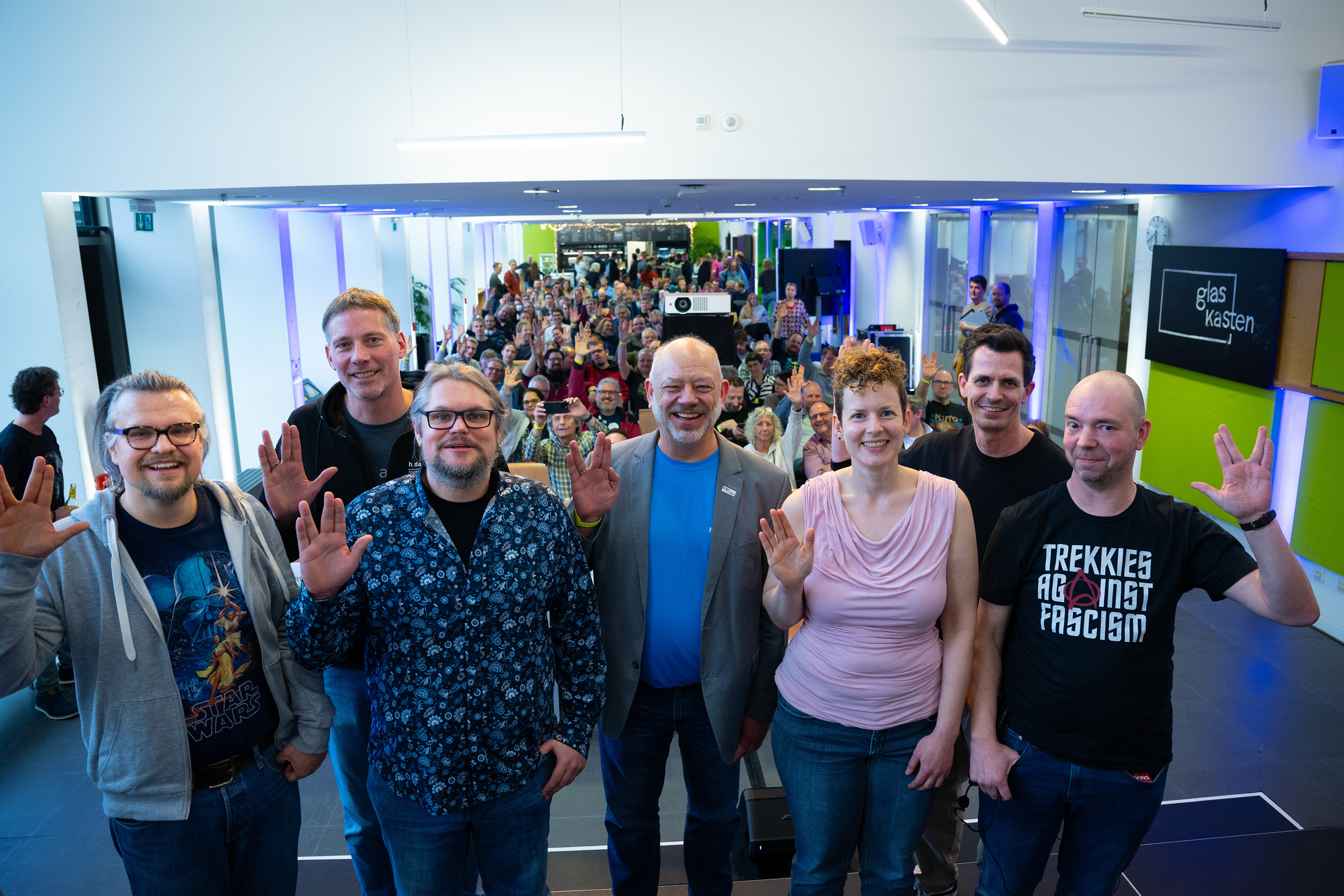
Stardate: March 2026. Glaskasten Café at h_da, space for Darmstadt University of Applied Science Fiction: all aboard for an adventurous four-hour journey with 260 guests to explore for the first time how much science there is in Star Trek fiction. Speakers and guests boldly go into interdisciplinary galaxies of knowledge where no one has gone before.
By Simon Colin, 10.3.2026
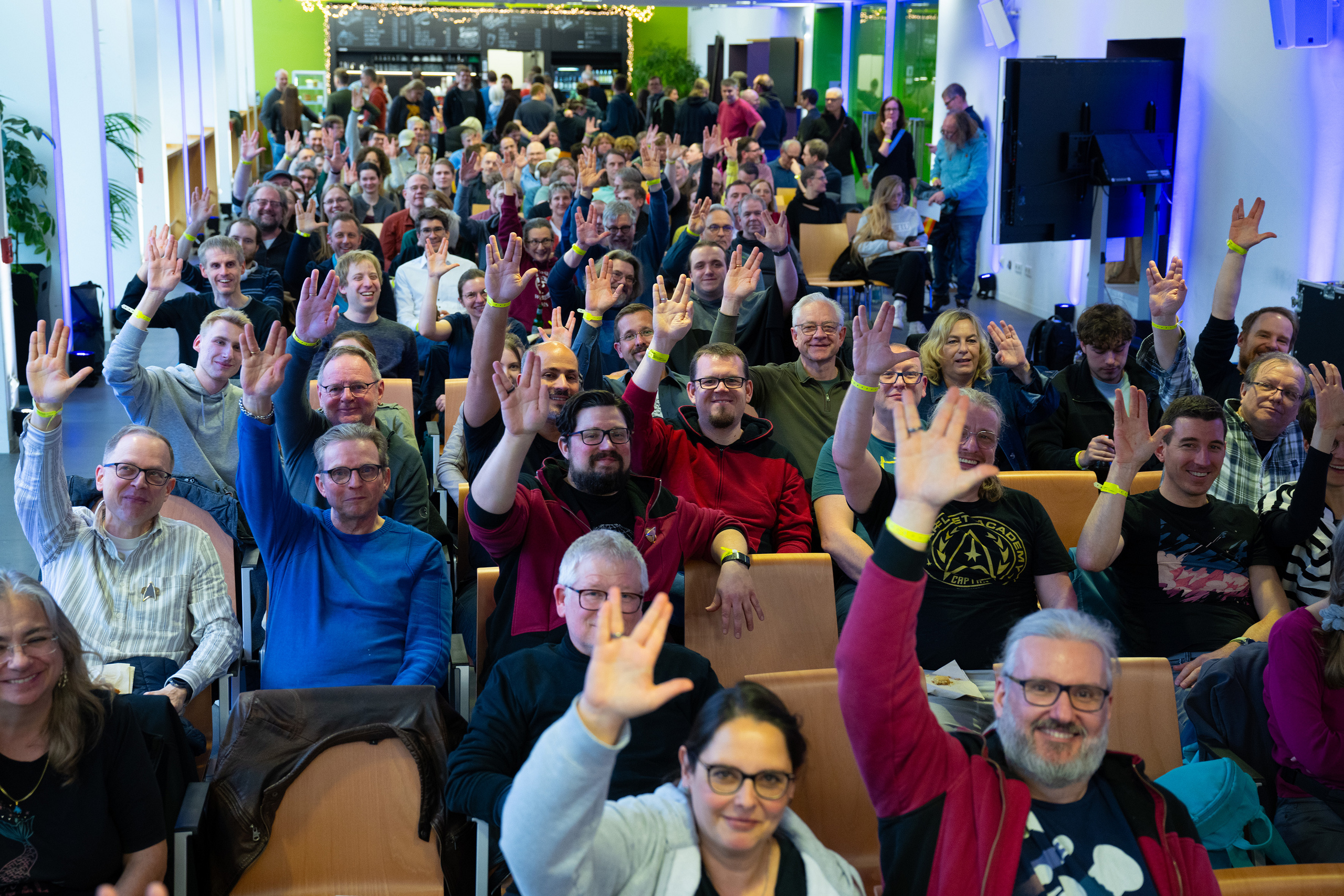
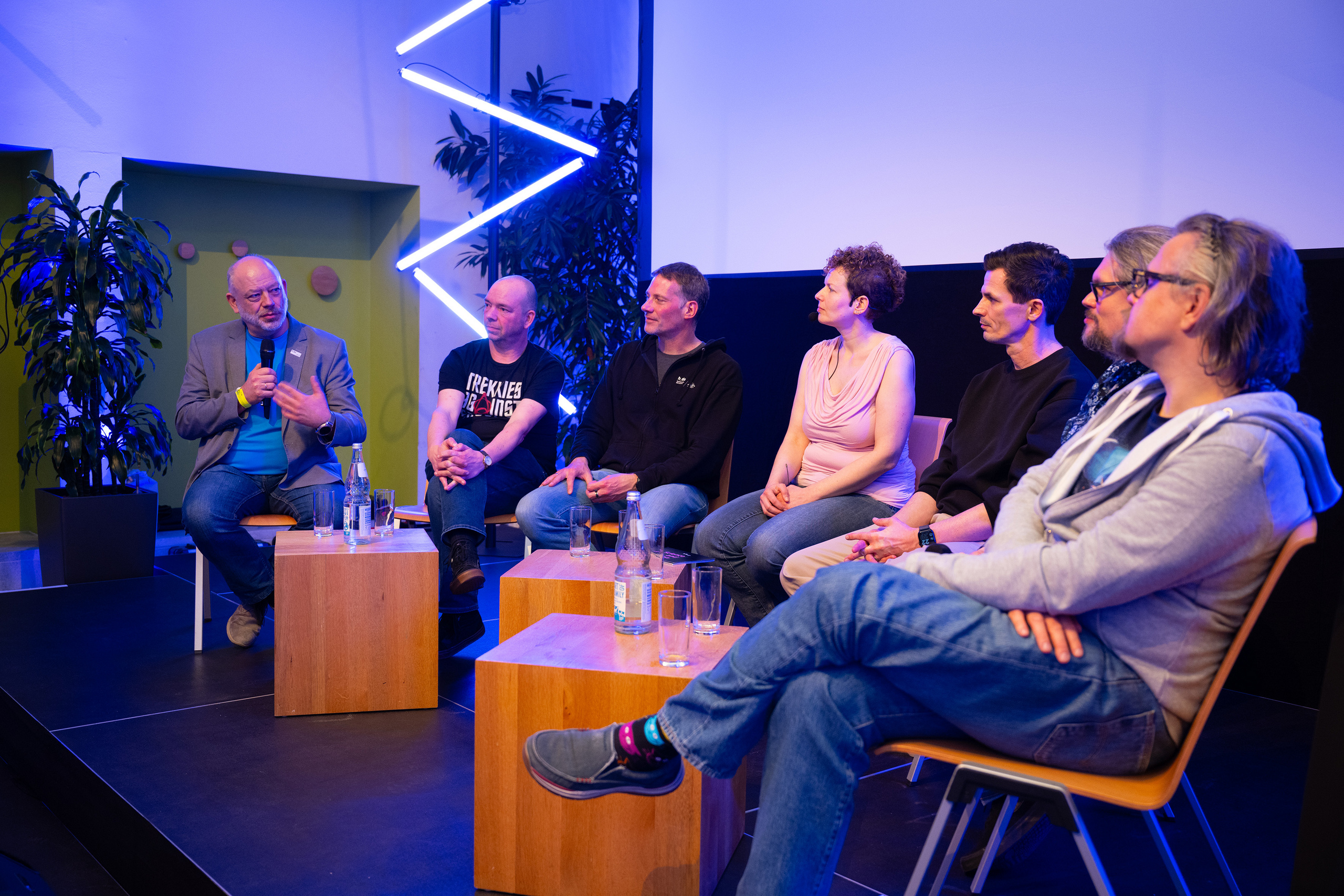
Cult series meets science at Darmstadt University of Applied Sciences (h_da). Over 260 Star Trek fans journeyed to the first Star Trek Day at h_da to witness the encounter between scientific perspectives and the Star Trek universe. The event in Glaskasten Café, which was filled to the last seat, lasted over four hours and revolved around “Science meets fiction – Star Trek in an interdisciplinary reality check”.
Computer science, design and social work researchers and experts analysed, from their specialist and scientific viewpoints, the numerous Enterprise series in relation to reality. The headliners of the evening, which Doris Winter moderated, were the “Trek on Tuesday” podcasters. The Gesellschaft zur Förderung technischen Nachwuchses Darmstadt e. V. (GFTN – Society for the Promotion of Young Technicians) and h_da’s Faculty of Computer Science provided financial support.
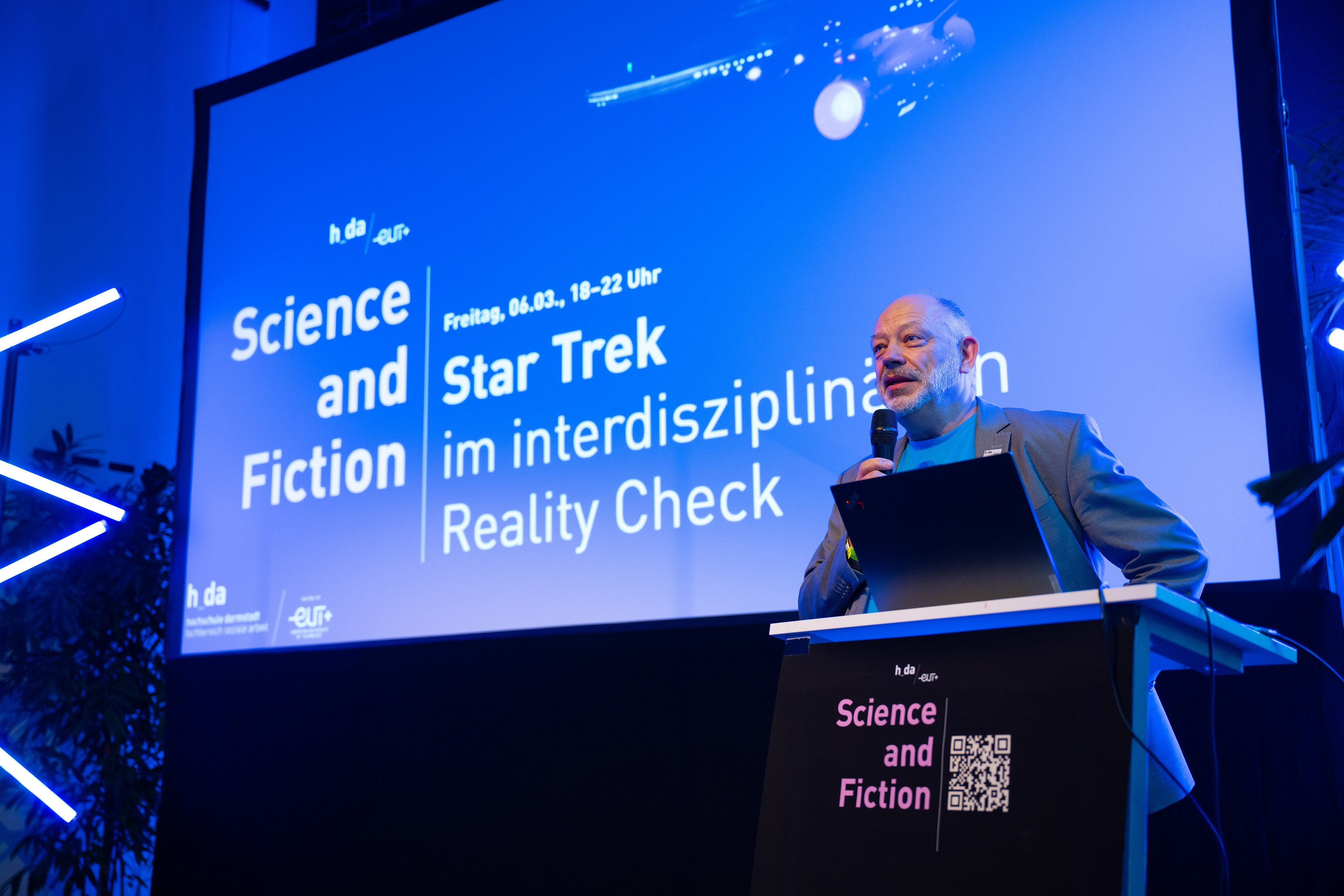
Right from the start, Professor Arnd Steinmetz, President of Darmstadt University of Applied Sciences, a self-proclaimed Trekkie, set the tone for the evening: “What I always found particularly touching about Star Trek is the positive spirit,” he said. “The future is not depicted as a threat, but as an opportunity: a time in which knowledge, cooperation and curiosity are more powerful than fear, narrow-mindedness and cynicism.”
Mass hacking on the motorway?
Thirsty for knowledge, the audience listened to the presentations, which were peppered with a dash of humour and nerdy facts, and applauded the speakers. Professor Christoph Krauß, automotive security expert at h_da’s Faculty of Computer Science, spoke about cybersecurity: “Shields up! Firewalls up! Cybersecurity in Star Trek. And why the Borg would hack your car.” He referred, among other things, to episodes of the series “Star Trek: Picard”, in which the Borg villains take over Starfleet, which is highly interconnected. Rescue is only possible thanks to an older and therefore autonomous Enterprise.
Are we at risk of a similar mass hacking in the future in our increasingly connected cars in the middle of rush hour traffic on the motorway? Among the experts working with the automotive industry to develop a secure infrastructure, which is not always guaranteed in the Enterprise cosmos, are Professor Christoph Krauß and his Applied Cyber Security Darmstadt research group. The Enterprise fails his light-hearted intergalactic cybersecurity check several times – but the audience nevertheless learns something: for example that passwords should not only be kept secret but as long and complex as possible. In “Star Trek: The Next Generation”, by contrast, they are often recklessly divulged.
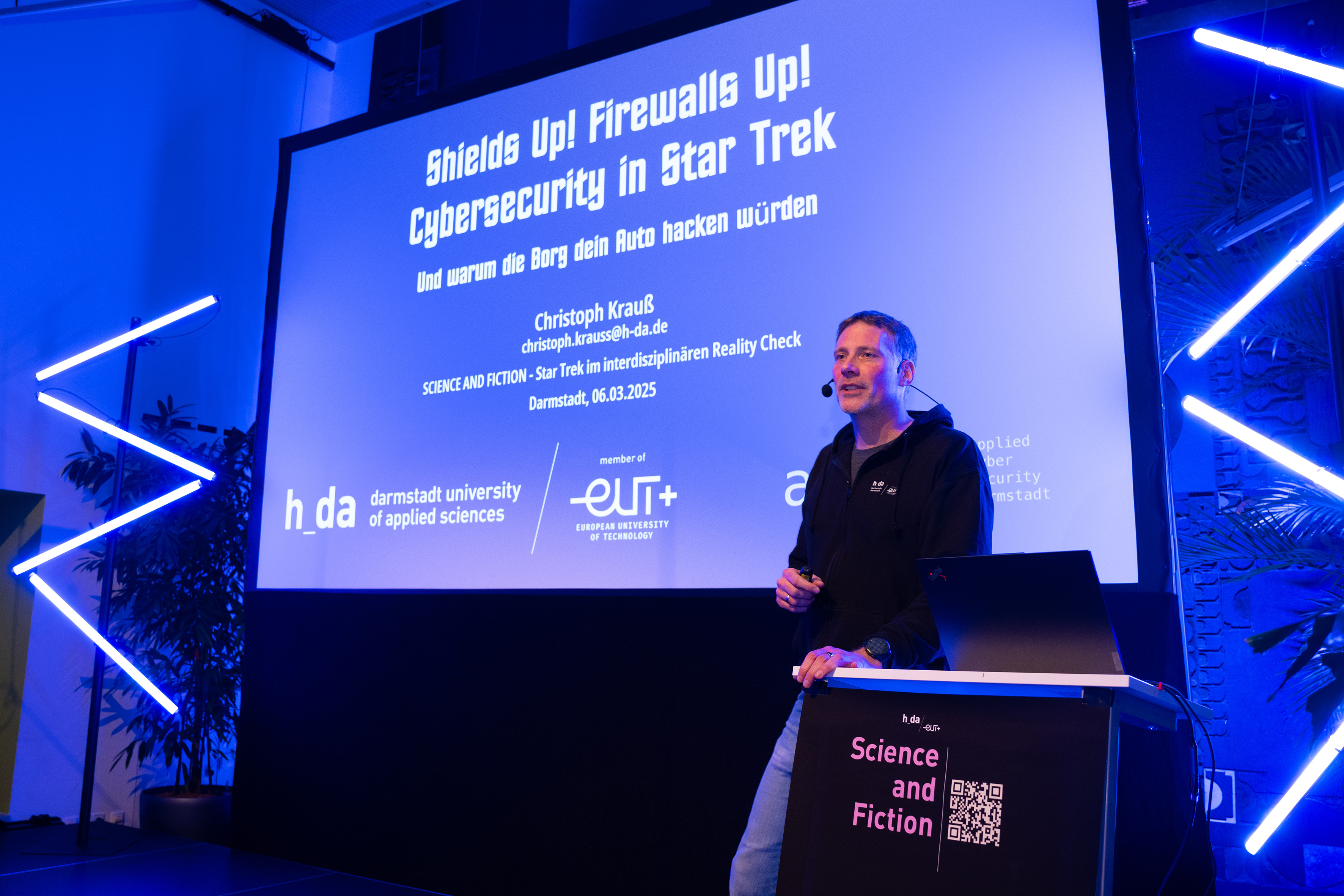
Malware is a topic that was already addressed in the series “Star Trek: Deep Space Nine” in the 1990s. In one episode, crew member Quark distributes tiresome advertisements for his bar. A classic case of adware. Only one thing can help: keep calm and don’t click on everything. Or as Christoph Krauß expresses it: “We ourselves are the biggest IT problem.”
Star Trek design is not always suitable for everyday use
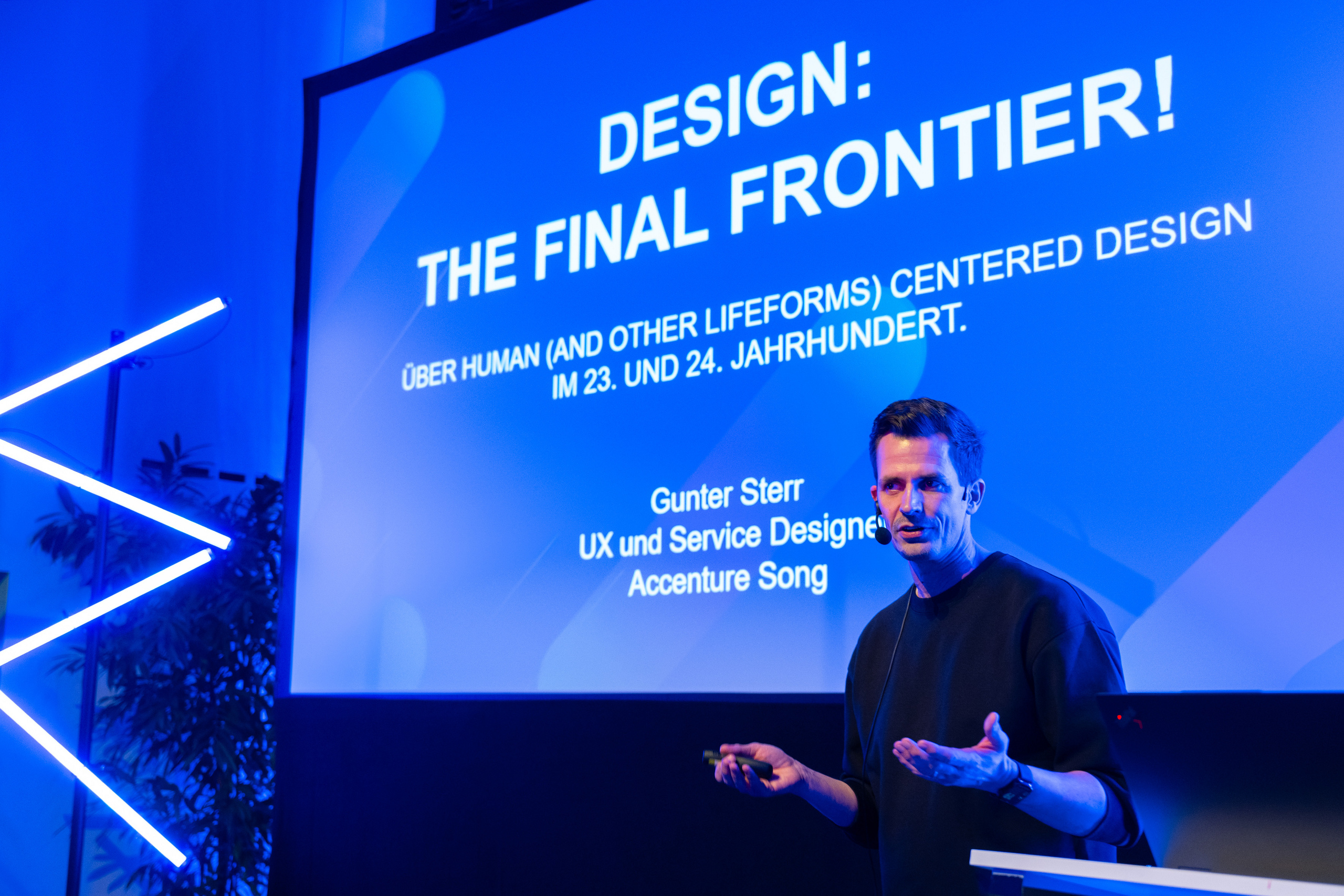
The lecture given by Gunter Sterr, h_da graduate and designer, focused on design for humans: “Design: The final frontier! On human- (and other lifeform-) centred design in the 23rd and 24th centuries”. Star Trek has inspired many designers as well as technology, he said. The communicator in the original series from the 1960s was the inspiration for today’s flip phone, for example. But Star Trek’s design for tomorrow is not always suitable for everyday use. Although the “PADDs” in the series resemble today’s tablets, for instance, they are only suitable for one application, which is why the protagonists are obliged to juggle several of them. According to Gunter Sterr, this leads to cognitive stress and can be solved more efficiently with contemporary technology. Design is not just about appearance, he says, but also about functionality.
In his opinion, there is also room for improvement as far as the starship’s bridge is concerned: face-to-face communication is not possible, as everyone is looking at the large screen, which makes interaction difficult. At the same time, there are not enough seats, meaning that occupational safety would be inadequate in the event of a hostile confrontation. “The bridge would not meet today’s certification norms,” said Gunter Sterr, referring to current ISO standards for the ergonomic design of control centres. That is why designers today, according to Sterr, need not only a feeling for aesthetics but also empathy for human needs, an understanding of functional and reliable systems, and an ethical consciousness of the limits of design.
Rules must sometimes be broken
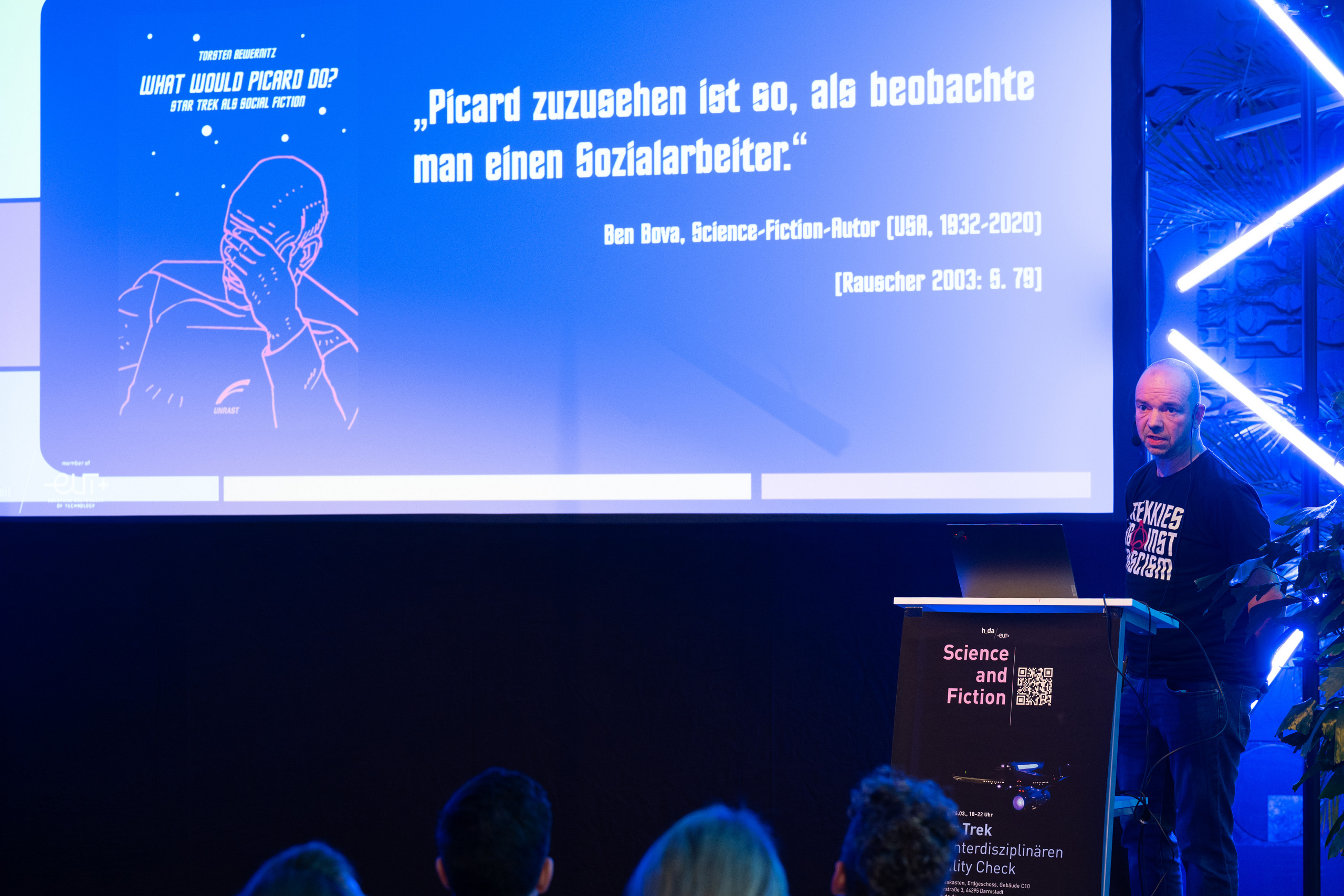
Professor Torsten Bewernitz highlighted the connection between Star Trek and social work in his lecture “Does social work need a ‘Prime Directive’?” Outside the classic series too, the Roddenberry Foundation, for example, which was founded in 2011, also undertakes social work. Actors from various franchises of the series have also championed social causes again and again, such as screenwriters’ rights.
Bewernitz also sees parallels between Starfleet missions and social work, such as is evident, he says, in the “Dual Mandate” of assistance and control. Under this mandate, Starfleet establishes contact with those seeking help and at the same time provides military protection for the Galactic Federation. Social workers, in turn, help people on behalf of the state and society. Both also share a “Triple Mandate”: research based on a code of ethics.
What, therefore, is the “Prime Directive” all about? Among other things, this guiding principle rules that Starfleet must not interfere in the development of other cultures and societies. However, these directives and rules must sometimes be broken for the good of precisely those cultures and societies. This also applies – in a figurative sense – to social work. But then someone must also take responsibility for breaking the rules.
Students and baby boomers rub shoulders
On the occasion of Star Trek’s 60th anniversary this year, Sebastian Göttling and Simon Fistrich, the two “Trek on Tuesday” podcasters, looked back on six decades of Enterprise “between idealism and production reality”. They took the audience on a journey from the “Western flavour” of the original series to “Star Trek: Enterprise” at the beginning of this century. They showed how Gene Roddenberry, the series’ creator, was as controversial as he was meritorious, and how he helped, for example, to keep the series from fading into obscurity by giving lectures at American universities in the 1970s.
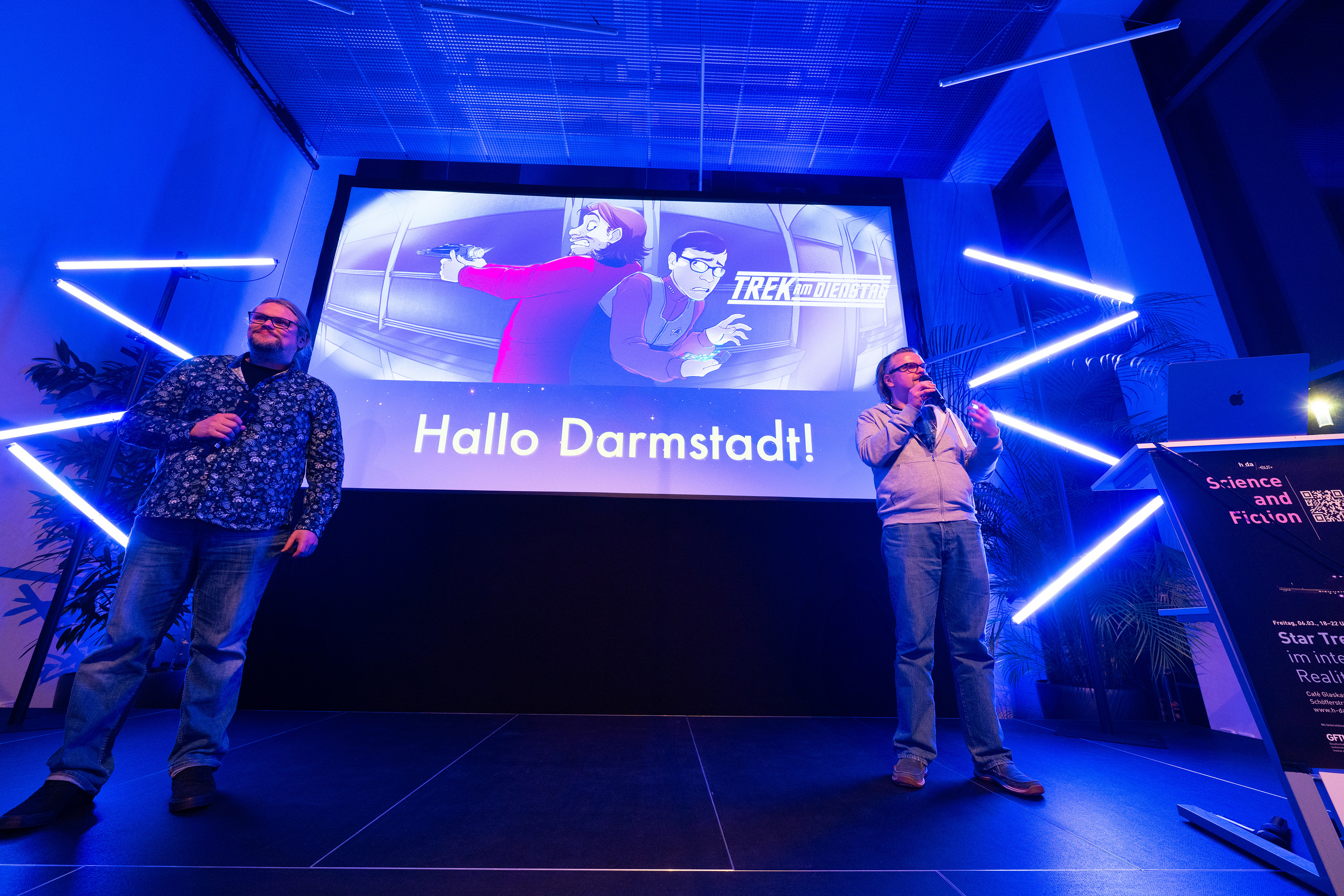
The series is still loved by fans today. It was they who formed a network in the United States in the 1970s, in this way significantly contributing to its continuing production. Re-runs of the original series on US television intensified this effect. That is also the reason why the original series is still particularly popular in the US today. In Germany, on the other hand, “Star Trek: The Next Generation” has a large following because the series aired on German TV in the 1990s at around lunchtime after school and attracted young viewers – the next generation of fans.
The audience at h_da’s first Star Trek Day is a mixed group. Fans of all ages indulge themselves between science and nostalgia. Students and baby boomers rub shoulders: Trekkies united. At the end of the day, Professor Arnd Steinmetz, President of h_da, sends a clear signal: more events of this kind are planned. After all, Star Trek is a franchise too.
“It’s the unknown that drives us forwards”
What happens next is written in the stars. But here is a fitting quote from Captain Kirk, which Steinmetz paraphrases: “It’s the unknown that drives us forward.” Even if this trust in the unknown, in research, innovation and social progress is often overshadowed in today’s culture of debate, as Steinmetz goes on to explain. “But the quest for understanding is ultimately the essence of science – and thus the essence of our mission as a university. This makes events like this, where we can reflect together on the future, technology, values and humanity and be inspired by a series whose fundamental message is ‘All can turn out well if we try hard enough’, all the more important.”
Contact our Editorial Team
Christina Janssen
Science Editor
University Communications
Tel.: +49.6151.533-60112
Email: christina.janssen@h-da.de
Translation: Sharon Oranski
Photography: Markus Schmidt