


Democracy Research

Put bluntly, democracy is under pressure. But what exactly does that mean – beyond headlines and election forecasts? And how does this pressure manifest itself in settings where democracy is practised in everyday life, such as in associations, initiatives and local networks? As a member of the Hessian research alliance “DemoReg”, Charlotte Dany, Professor of Organisational Communication and Development at Darmstadt University of Applied Sciences (h_da), is looking at how democratic regression is perceivable in civil society. A conversation about co-optation and openness, facts and feelings – and the question of how much conflict democracy can tolerate.
Interview: Christina Janssen, 2.2.2026
impact: “DemoReg” is a large research alliance, and the topics are complex. What’s it all about?
Dany: “DemoReg” is an acronym for “Democratic Regression”. The alliance encompasses around 35 researchers from throughout the whole of Hesse, from universities and non-university research institutions. First, it’s concerned with the fundamental question of what democratic regression actually means. We hear all the time that democracy is facing a crisis or collapsing. Regression is a concept we want to use to capture these developments more accurately.
impact: What is the difference between regression and retrogression?
Dany: Retrogression implies – as does progress – a linear, temporal development. But it’s not that simple. Democracy has always been contested and has constantly changed. That’s why we understand regression rather as a complex transformation process that does not take place in a linear way. It’s not simply about moving forwards or backwards, but instead about shifts and renegotiations of democratic practice – or its undermining.
impact: What specific perspective is h_da contributing to the research project?
Dany: We are examining how democratic regression has an impact on civil society – more specifically on associations and initiatives in Hesse, that is, sports clubs, fire brigades, cultural or political initiatives. These are settings where democracy is practised in everyday life, but where it can also come under pressure.
impact: What exactly do you mean?
Dany: What we are seeing at present is the rise of right-wing populist parties in many European countries and a normalisation of extreme right-wing attitudes among the population. This manifests itself not only in elections but also in everyday life, in families, in conversations and in community life, for example in clubs and associations. Extreme right-wing stakeholders are deliberately trying to reach out to people through such clubs and associations and to build trust, especially among young people. You could call this infiltration or co-optation.
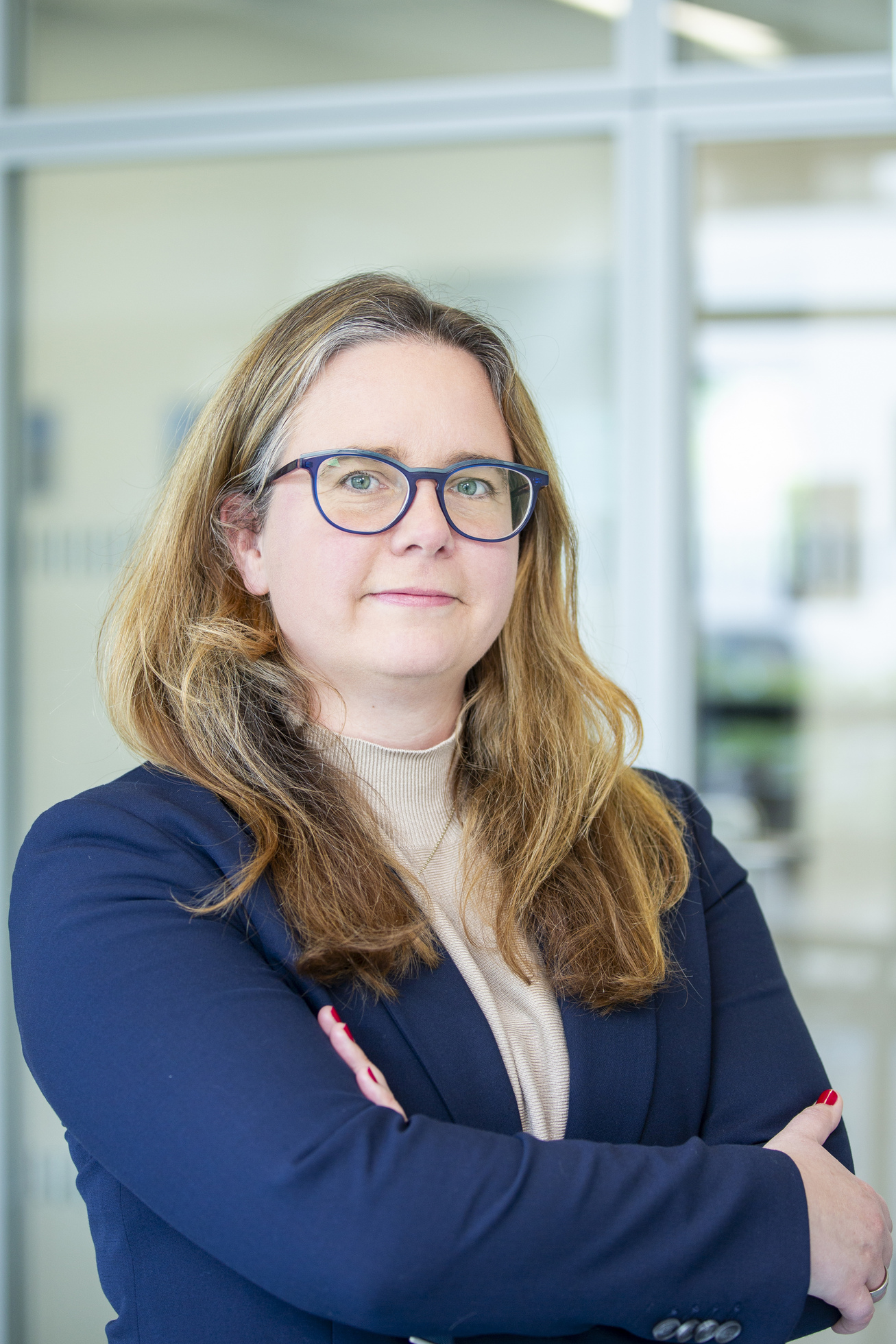
Charlotte Dany has been Professor of Organisational Communication and Development at h_da’s Faculty of Social Sciences since March 2023. For three years before joining h_da, she was the managing director of the Peace Academy Rhineland-Palatinate (RPTU), an institution set up to study peace and conflict issues in science and society. Prior to that, she worked for several years as a postdoctoral researcher at Goethe University Frankfurt. Charlotte Dany holds a postdoctoral degree (Habilitation) in political science. Her research and teaching centre on peace, conflict and democracy studies, particularly NGOs, civil society and questions of disaster relief, emergency aid and organisational policy in humanitarian operations.
impact: Is that already an example of “democratic regression”?
Dany: It can be an expression of it. Another aspect is the growing political and economic pressure put on civil society organisations – by shedding doubt on their non-profit status, accusing them of a lack neutrality, withdrawing their funding. If this prevents people from playing an active part, we speak of regressive tendencies. The question of whether we can already speak of this as a widespread phenomenon is part of our research. The project aims to find out for Hesse: How do such regressive tendencies curtail the democratic function of civil society? And how can civil society initiatives react to this?
impact: Can you please describe your approach?
Dany: We conduct qualitative interviews on site. We sound out the situation, talk to associations and advice centres, for example those engaged in democracy work. The aim is to identify examples of conflicts in Hesse, which we then examine in depth, with further interviews, for instance, as well as media analyses and participatory formats. But we don’t just look at that part of civil society automatically associated with democracy and diversity but also, for example, at shooting clubs or the Landfrauen in Hessen, a women’s organisation active in rural areas that also does a lot of work to foster democracy. And, of course, there are also groups in civil society that we must regard as a threat to democracy.
impact: Which participatory elements does your research include?
Dany: We are planning events with participants from all social groups. In the spring, we will organise a workshop with active young people at the University of Kassel to share thoughts and ideas and engage in networking. Together with the Evangelische Akademie Frankfurt, the Protestant Academy in Frankfurt, we are thinking about an event that should bring together the urban public in Frankfurt – as diverse a group as possible, the entire spectrum. We want to hear what people are discussing and will incorporate this into our research.
impact: Isn’t it often a problem when talking to people with different values that the facts fail to make an impact? Studies show that it’s easier to reach people on an emotional level. How do you handle this as a scientist?
Dany: That’s a very important point. We know, of course, that in the event of a conflict it doesn’t help to put the facts on the table from a “knowledgeable” position. On the contrary, you have to be prepared to listen. Democracy is also a matter of emotions. These emotions show us something, such as how serious a conflict is or where its roots lie. We initially include that in our research at face value, without focusing too much on our own emotions or immediately opposing it with supposed facts.
impact: At the end of the day, however, it’s also about “practical benefit”. What is the project’s intended outcome?
Dany: Alongside scientific publications, we want to develop something usable for associations in their everyday operations – not a rigid catalogue of measures, but instead a kind of guideline. What dilemmas exist? Which strategies have proven successful? Many associations have already developed their own solutions. We want to bundle these systematically and highlight them. In addition, researchers in the eastern German states have already produced some good studies that are very practice-oriented. We want to see which experiences are transferable to western Germany.
impact: You mention dilemmas. Could you please give us an example to explain what you mean?
Dany: Imagine that a hard-working member of an association also occupies a key position in a right-wing extremist youth organisation. They are good at their job, popular and perhaps a role model for young people. Excluding them from the association contradicts the ideal of openness and inclusion, but doing nothing can equally undermine democratic values. This field of tension is difficult to resolve – legally, morally and practically.
impact: What is your personal motivation for exploring these questions?
Dany: What motivates me is the idea of civil society as a democratic force. And I’m delighted that the “DemoReg” project presents an opportunity to bolster civil society. Hambach, the town where I live, has had a formative effect on my life. Hambach Castle is representative of democratic history. We moved there at the time when people were starting to stage right-wing marches around the castle, so-called “reenactments” of the Hambach Festival – always in the name of democracy. Initially, the local authority and the foundation responsible for the castle’s administration chose not to respond. Perhaps they didn’t see that there was a problem, or they didn’t want to be labelled a “Nazi rallying ground”. A mistake from the outset, in my opinion, and it proved to be a poor strategy as well. That’s why the local authority later changed its strategy, also due to pressure from civil society initiatives. And that’s what led me to my current topic. I asked myself: Where else is this happening, and how can we retaliate when both sides are campaigning in the name of democracy?
impact: The “DemoReg” project will run until 2028. What do you want to have achieved by then?
Dany: A solid empirical basis, reliable analyses and above all results that have an effect outside science as well. Democracy problems do not disappear by themselves. This makes it all the more important to be prepared – arm in arm with those who uphold democracy on a daily basis.
Contact the science editorial team
Christina Janssen
Science Editor
University Communications
Tel.: +49.6151.533-60112
Email: christina.janssen@h-da.de
Translation: Sharon Oranski
Links
Professor Charlotte Dany’s website (in German only)
Project information provided by the Hessian Ministry of Science and Research, Arts and Culture (in German only)