


Climate Journalismus and Social Media Algorithms

Today, algorithms play a central role in deciding which topics become visible – and which do not. For journalists, especially in the area of social media, they have become a key but hardly calculable factor. As part of her dissertation, Vanessa Kokoschka, a doctoral student at the Faculty of Media, Darmstadt University of Applied Sciences (h_da), is examining how algorithms influence journalists’ decisions at the precise point where quality journalism is particularly challenged: on social media. Using the example of climate change, Kokoschka is also looking in general at how complex topics can be communicated to young people and how the “broccoli method” can help.
By Christina Janssen, 21.1.2026
Vanessa Kokoschka’s work centres on a simple question, but one that has a significant impact: How do algorithms influence editorial decisions? More specifically, she is examining social media formats that deal with climate policy and climate science – on platforms such as Instagram, TikTok and YouTube, which serve as news sources above all for young consumers.
To do this, Kokoschka followed the work, as an “embedded scientist”, of the Deutsche Welle broadcasting company in Berlin, where the “Planet A” format is produced for TikTok and YouTube. She also took a close look at the editorial team behind the WDR Instagram format “klimaneutral” in Düsseldorf. Both teams work almost exclusively for digital platforms. “Although some content will also be adapted for linear programming later on,” explains the young researcher, “the primary channel for these editorial teams is clearly social media.” To obtain as complete a picture as possible for her dissertation, Kokoschka also conducted a comprehensive analysis of the content of climate journalism formats on social media and a series of interviews with journalists from various media companies.
What Kokoschka finds particularly interesting is how editorial teams interpret metrics: drop-off rates, reach, user engagement through clicks or comments. “Which indicators do they consider relevant? What conclusions do they draw from them? And how do they incorporate these findings into production?” These are Kokoschka’s central research questions. In editorial meetings, she observed how journalists interpreted numbers – and how such interpretations lead to new dramaturgical decisions.

Here it can be seen that editorial offices are moving in an area of great uncertainty. “No one knows exactly how the algorithms work, but many work processes are guided by them nevertheless,” says Kokoschka. She describes this relationship as a mixture of pragmatism and permanent guesswork –with more than a hint of trial and error. To give an example: in one of the interviews with experts Kokoschka conducted for her dissertation, an editor compared today’s view of algorithms to the medieval image of God. If things go well, you have done everything right and will be rewarded for it. If things go badly, you have angered the algorithm and will be punished accordingly.
Battle for attention
Such uncertainty, reports Kokoschka, was particularly high as a result of the “omnipotence” of algorithms during a period when Instagram temporarily limited political content. Reach decreased noticeably, and the pressure on editorial teams increased. “As a consequence, editors developed strategies to regain attention, for example through more polarising introductions, prominent political figures and provocative images.”
It should therefore come as no surprise when politicians such as Markus Söder or Christian Lindner, for example, appear in climate posts: this has less to do with their stance on climate policy than with their potential for “rallying the troops”. Kokoschka stresses that this approach does not inevitably go hand in hand with a flattening of content. These eyecatchers often serve only as “bait”, for instance as the first slide in a carousel post. Only then does the actual journalistic content follow, fact-based and in line with conventional journalistic quality criteria.
A mind of their own…
Social media algorithms automatically decide what is displayed to which user – according to constantly changing criteria. For editorial teams, the underlying mechanisms are nebulous. Even experts cannot explain why one post attracts attention while another does not. As a result, it is impossible to forecast success with any degree of reliability, and reach is volatile: good content can go under, while mediocre content can go viral – timing, user behaviour and chance play a key role. This means that reach, that is, the measurable “success” of a post or story, has nothing to do with (journalistic) quality. It is the outcome of a complex, unpredictable system.
Another trick in the daily battle for attention is the “broccoli method”: just as parents hide vegetables in their children’s meals, editorial offices try to communicate climate topics in such a way that they are not immediately “penalised” by algorithms. “Terms such as ‘climate crisis’ or ‘climate change’ are avoided, but without the actual message being lost,” explains Kokoschka. The broccoli is still there – it’s just not lying on the plate for all to see but instead stirred into a puree in a “snackable” form.
Same content, different wrapping
One result of Kokoschka’s work is thus the realisation that packaging and content need to be distinguished: although algorithms influence the dramaturgy, layout and introduction of a story, sovereignty over the topics covered remains with the respective editorial team, at least in the case of quality media. Content that is clearly only going to have a limited reach will also continue to be produced – out of journalistic responsibility.
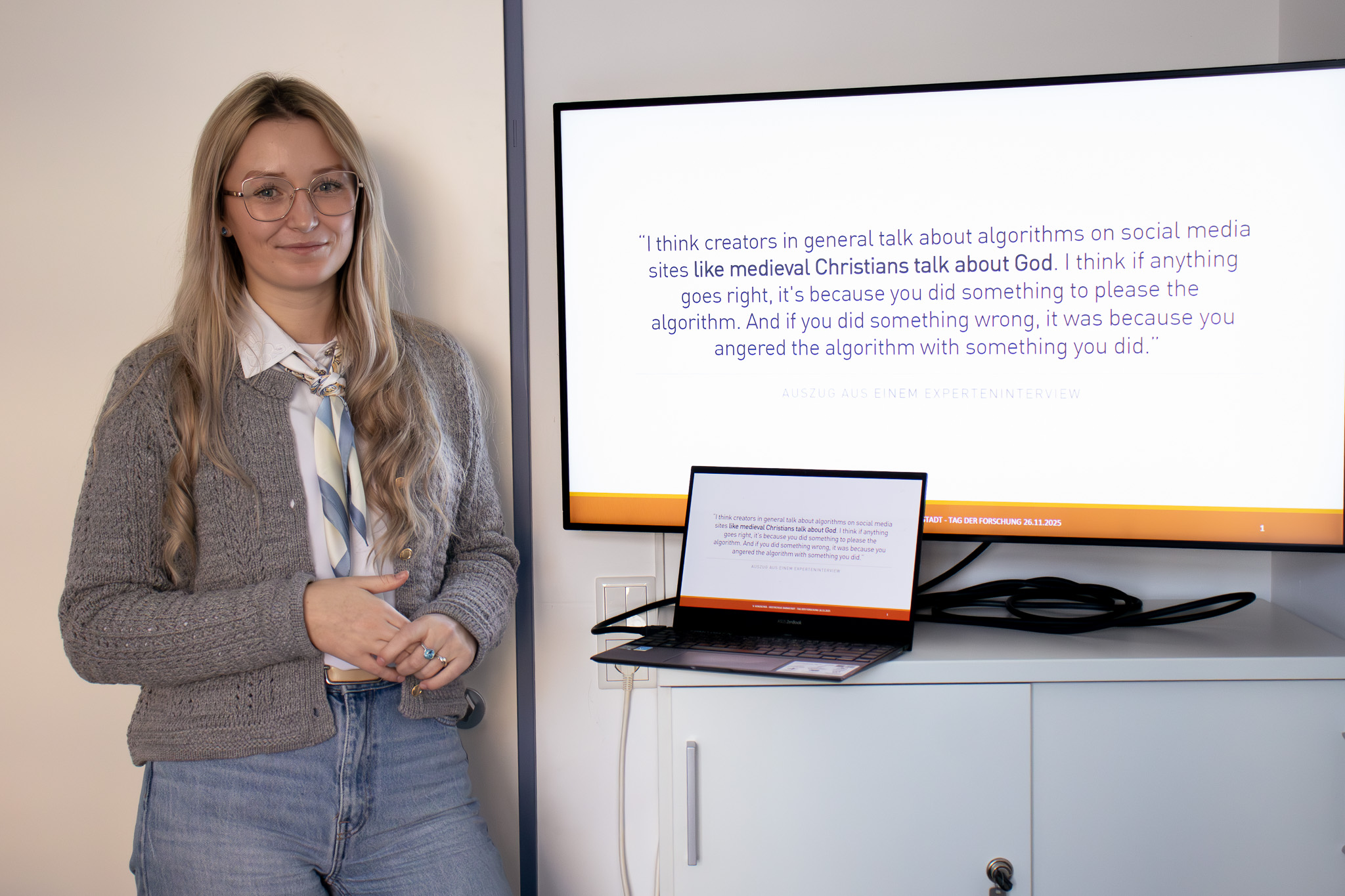
The influence of algorithms on content therefore manifests itself less in the “if” than in the “how”. This proves particularly challenging when it comes to environmental policy, which is often associated with negative connotations such as bans or disasters. Climate policy is difficult to show in pictures – beyond images of baby polar bears drifting on ice floes. It creates hardly any direct emotional closeness and competes on social media with other, highly polarising political issues. “YouTube still offers comparatively extensive scope for deeper content, and consumers often consciously watch longer videos,” says Kokoschka, “but on platforms such as TikTok, by contrast, whether content is noticed at all is decided in just a few seconds.” Shortening content is not a trend, but a structural necessity.
Journalism was her childhood dream
Kokoschka, 28, says that studying online journalism has enabled her to fulfil a childhood dream. “It already began when I was allowed to play editor-in-chief of the school newspaper in primary school,” she recalls. During her studies, she gathered extensive practical experience in journalism with local publishers and worked for the German Press Agency, among others. “That means working at a fast pace, intense time pressure and sticking strictly to the facts – it was very challenging and a good lesson in stress resistance.” After her Master’s degree, Kokoschka made a conscious decision to pursue an academic career and immediately started her doctoral degree – made possible by a permanent position at h_da, which also includes teaching. She is already passing on her knowledge to younger students with great enthusiasm.
“I can imagine becoming a professor in the long term,” says Kokoschka about her career ambitions. First, however, she wants to spend the next few years gaining some practical professional experience – in public broadcasting or corporate communications. Keeping her options open also mirrors her view of the future of journalism: critical, but without cultural pessimism. The young researcher paints a sober picture of the industry’s future: “Economic pressure, job cuts and the use of AI are changing it noticeably.”
Responsibility of large media companies and political parties
Kokoschka nevertheless sees it as the responsibility of public broadcasters and large publishing houses to provide reliable information, especially on social media. Incidentally, this also applies to political parties: “When we see how many votes the Alternative for Germany is winning via social media and how the Left Party is benefiting from TikTok, we must ask: What is the political centre doing?” Kokoschka cites a study by the Otto Brenner Foundation, which concluded that parties on the political fringes profit above all from the inadequate social media skills of their rivals. “So more should be invested here.”
Algorithms are neither a promise of salvation nor a doomsday scenario. They are a general framework that journalism has to handle. To what extent editorial offices succeed here is determined less by algorithmic codes and more by the editorial decisions made anew every day by people.
Contact the science editorial team
Christina Janssen
Science Editor
University Communications
Tel.: +49.6151.533-60112
Email: christina.janssen@h-da.de
Translation: Sharon Oranski
![[Translate to EN:] Blick von oben auf jungen Menschen in einer Arbeitssituation mit Laptops an einem Tisch](/fileadmin/user_upload/26_01_Kokoschka_Foto_rechte_Spalte.jpg)
Overview of study programmes on h_da’s Media Campus in Dieburg:
mediencampus.h-da.de/studium/