


How good AI communication makes us better conversationalists

ChatGPT was put to the test and asked to help formulate questions. The experiment went radically wrong. However, anyone who seeks to place the “blame” squarely on the AI for this will be surprised to hear what Ingo Hamm, Professor of Business Psychology at Darmstadt University of Applied Sciences (h_da), has to say. According to him, the problem is always located in front of the computer. In this interview for impact, he explains why we might learn from a machine, of all things, how to communicate better.
Interview: Christina Janssen, 14.7.2026
impact: Before our meeting, I tested ChatGPT and asked it to come up with ten clever interview questions. To be honest, the result was totally unusable.
Professor Ingo Hamm: It’s funny you say that. Quite a few journalists have done that in the past. It’s the obvious thing to do with a topic like this. And the reaction was always the same.
impact: Where does the problem lie?
Hamm: That takes us straight to the heart of the matter. It’s presumably due to a lack of context. Overall, I don’t doubt that an AI system would be capable of asking intelligent questions. But it would likely require a lot of input from us. Most people try to formulate their request in a single sentence, such as “I want a document” or “The students need to produce a dissertation.” We think that AI is clever and will know what to do. But it doesn’t. That’s why you would have to explain much more precisely what you want: “These are Ingo Hamm’s hypotheses. The background is as follows. The interview is intended for a certain target group.” And so on. That would produce better results.
impact: Meaning the problem was me, and not ChatGPT?
Hamm: Exactly. The problem is always located in front of the computer
It doesn’t work without context
impact: Then I’m glad we’re both sitting in front of the computer for this interview...
Hamm (laughs): That’s precisely the point. If I enter just one sentence and expect a great result, more often than not I’m going to be disappointed. But if I make an effort, if I’m prepared to engage in a dialogue, if I’m happy to share my knowledge, rather than expecting a wealth of content in a matter of seconds from a small app. And I experience exactly the same thing in the office as a specialist or manager when it comes to teamwork: you can’t just shout out to your colleague down the corridor and say, “I need a report by tomorrow.” It’s about putting your heads together. “What do I know? What do you know? What’s your background?” That’s how proper communication in the office functions – and likewise in front of the computer.
impact: Meaning I should talk to AI like I would to a human being?
Hamm: The funny thing is that there are managers who have meanwhile learnt to communicate clearly in an IT context – but not with their staff. They still don’t know how. That’s why I’m in favour of such mutual learning. The technical aspects of using AI effectively can teach you something about good communication. Conversely, I can also transpose the rules of good communication to my use of AI.
AI as a mirror of our communication
impact: Why is that?
Hamm: To many people, this initially comes as a surprise because they forget what AI is. AI systems such as ChatGPT are language models. They are based on human communication – on documents, dialogues, books, films, etc. After all, it’s not brains that have been replicated, but communication. Consequently, it’s only logical to say that AI’s modus operandi is a communicative one. It draws, of course, on a vast repository of knowledge, but it follows the rules of good communication. This means that if I communicate well with AI, I can transpose this to human-to-human communication.
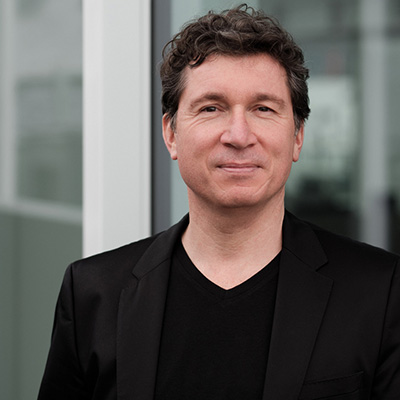
About Ingo Hamm
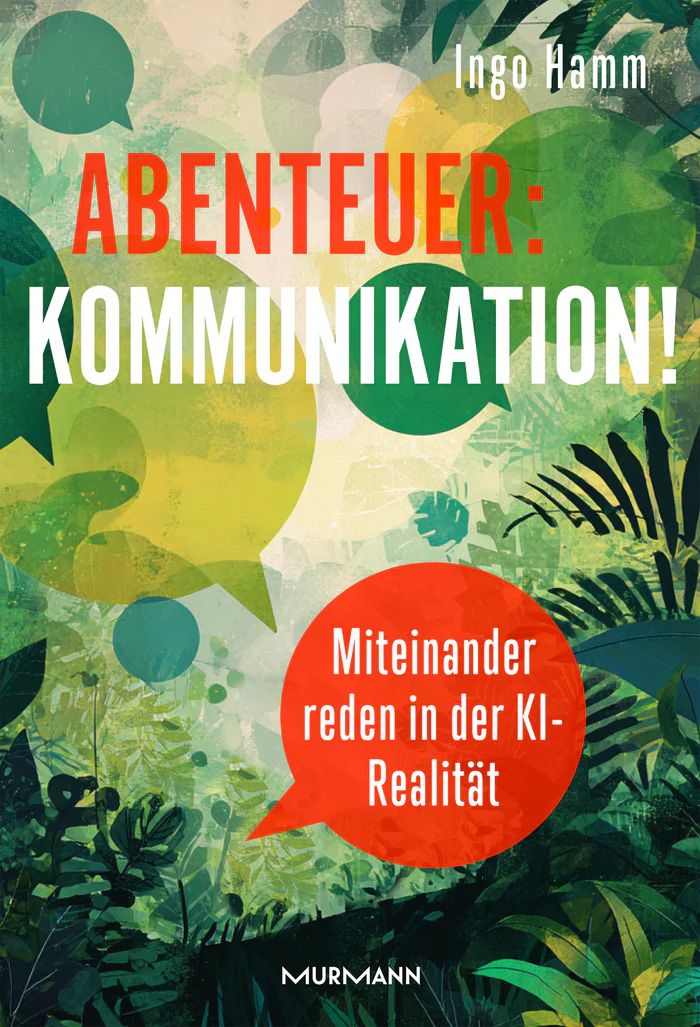
Ingo Hamm is Professor of Business Psychology at Darmstadt University of Applied Sciences (h_da). After studying psychology and economics, he initially worked as a management consultant and then led international projects for a large corporation. He joined the university in 2015. His research focuses on the future of work, among other topics. Hamm is the author of numerous non-fiction books, most recently “Abenteuer: Kommunikation! Miteinander reden in der KI-Realität”. Photo: Julian Beekmann
impact: You can understand, can’t you, that this idea might alienate some people?
Hamm: Yes, because we’re talking about different types of communication. In everyday life, there is a lot of purely social communication. In this interpersonal domain – in the corridor, in the office kitchen, in the pedestrian zone, throughout the world – we are integrated as social beings. By contrast, I am looking at a more informative form of communication whose purpose is to share information in work relationships, initiate projects and processes and regulate the way we work together. It is this kind of communication that I’m focusing on. I am not saying that machines will replace our social communication and the human dimension.
Universal rules of communication
impact: What makes for good communication – regardless of the setting?
Hamm: Here is a good example based on a real-life case. Imagine a manager – let’s call her Anne – uses AI and asks: “What’s burnout?” The AI would say: “Listen, Anne, these are the first warning signs. You ought to see a doctor.” What nobody knows is that Anne wasn’t asking for herself but in relation to a member of her staff: she wanted to know how she, as their supervisor, can support them. But the AI lacked the context. And that’s the first rule of good communication: providing the context. “Who am I? What’s my role? What’s my task? What do I expect from you? What end result do I want? What should happen?” This also forces me to think beforehand about what I want from my counterpart in the first place. That has always been a golden rule of good communication. But we’ve lost sight of it somewhat in recent years because digital communication has increasingly led us to condense what we want to say.
impact: And AI is now giving us the opportunity to learn the basic rules of communication anew?
Hamm: That is my hypothesis. As far as I know, however, no studies on this topic exist yet. I have initiated the first research work on it. Interestingly, I came across it in a roundabout way. I looked at what computer scientists had published on how to get AI systems to produce better results. And what I observed was the age-old principles of good communication. That’s why I asked myself: “Why don’t we transpose these principles to our everyday lives again?”
AI beyond fear-mongering debate
impact: That is a very optimistic view of AI. Overall, the debate about it tends to be characterised by cultural pessimism.
Hamm: I can only recommend adopting a different psychological perspective on AI. We shouldn’t picture a muscle-bound Terminator who will one day snatch global domination from us. Language models are chatty, but vastly knowledgeable systems. They are valuable as dialogue partners. In the future, AI systems will, of course, take over tasks previously performed by humans. But in my opinion, we are still a long way away from seeing a system that will make us superfluous or even strip us of our power. I see them rather as valuable extensions to many technologies that we are already using anyway.
impact: In an interview for the Frankfurter Rundschau newspaper you said: “Make Prompts, not War.” Many a crisis could be averted, you said, if only we followed the rules of good communication. But doesn’t this fail all too often because of emotions, defiance and unwillingness, rather than a lack of communication skills? People like Trump or Putin opt very consciously for aggressive, destructive rhetoric. And ultimately, that is precisely what constitutes a key difference between humans and machines.
Hamm: That is also psychology. Unfortunately, the social aspect also has major disadvantages. Repeatedly throughout world history, there have been individuals who have brought immeasurable misery upon others. And I can only confront these human failings in a human way – with the collective intelligence, wisdom and genuine social potency of human beings. I must leave the digital world and enter real everyday life, where we can and must be fully human once again. That would make a real impact on the world.
impact: Regardless of how good “AI communication” might be, it cannot prevent wars?
Hamm: Theoretically, it probably could. We would have received some brilliant analyses of how we might have acted. But the final decision nevertheless lies with human beings.
AI, the chatterbox
impact: Where do you personally see AI’s greatest potential?
Hamm: In programming. That’s where the systems really excel. At first, you think it’s incredibly complicated. Interestingly, you realise in the process that – as languages – programming languages function in a very simple way, using looping, branching criteria and clear rules. In fact, it’s not surprising that AI is particularly good in this area.
impact: Have you also learnt anything surprising about yourself through using AI?
Hamm: Perhaps not about myself. But I have got a wonderful anecdote for you. I once tried to reproduce a focus group with AI agents. Several AI systems discussed among themselves, and one of them was the moderator. And the funny thing about it? They refused to stop talking. The AI moderating the debate kept saying: “Thank you very much, that’s all for now.” And another one chimed in again immediately and said: “I’d like to add something.” And so it went on and on. Eventually, I had to end the experiment myself. I learnt from this just how much various social conventions matter when it comes to communication. A moderator doesn’t just say: “Ok, we’re done.” They might stand up. In a restaurant, the waiters put the chairs up on the tables, and everyone knows it’s closing time. These are cultural signals. That is also communication.
impact: Incidentally, that was the only question I borrowed from ChatGPT.
Hamm (laughs): Congratulations to ChatGPT!
Contact our Editorial Team
Christina JanssenScience Editor
University Communications
Tel.: +49.6151.533-60112
Email: christina.janssen@h-da.de
Translation: Sharon Oranski
Links
Professor Ingo Hamm’s website (in German only)