DFG Project: Post-Quantum Cryptography
Everything is up and running as usual: banking apps, Wi-Fi, charging stations for electric cars. But what would happen if a quantum computer suddenly rendered all encryption methods commonly used today ineffective? A research alliance composed of Darmstadt University of Applied Sciences (h_da), Hochschule RheinMain – University of Applied Sciences and Arts (HSRM) and the Max Planck Institute for Security and Privacy (MPI-SP) is working on ways to prevent this – and rethinking cryptography in the process. The German Research Foundation (DFG) is funding their project with around €750,000.
By Christina Janssen, 21.4.2026
Let’s imagine a perfectly normal day – but with one small twist: the money you had in the bank has been transferred to an account in the Cayman Islands, someone has charged their electric car at your expense, your Wi-Fi has been hacked, and a stranger has read your WhatsApp messages. Welcome to Q-Day, the digital doomsday when conventional encryption is for the most part no longer secure and all digital doors are wide open to attackers with quantum computers.
“The quantum computer is a disruptive phenomenon in technology,” says Marc Stöttinger, Professor of Computer Science at HSRM. And this disruption undermines, of all things, the very foundation of our digital world: cryptography, whose job today is to ensure that data remains confidential, identities are verified, and no one can snoop around in secret. Or, as Christoph Krauß, Professor of Computer Science at h_da, says, putting it in a nutshell: “Cryptography is a shield that protects our digital society.”
Q-Day will come – but when?
This protective shield is invisible. It is embedded in messaging services, industrial facilities and power grids. “Where doesn’t the Internet come into play? Precisely. It’s everywhere,” says Stöttinger. And that is why problems could arise everywhere as well. To explain the technical background: common encryption methods are based on mathematical problems that conventional computers are hardly able to crack. The quantum computer, by contrast, manages to do just that: “A quantum computer is capable of efficiently solving some of these mathematical problems,” explains Stöttinger.
The repercussions range from data leaks to massive interference in critical infrastructure. Krauß describes a possible scenario: “An attacker could smuggle control commands into an industrial plant or a power grid and switch off the electricity supply.” No one knows exactly when Q-Day will come. “Tomorrow,” says Stöttinger dryly. But then he modifies his answer by saying it could also take another ten or twenty years. Krauß is pragmatic: “We should always assume that it might happen very quickly.” That is why the Federal Office for Information Security (BSI) has warned about this threat for years and urged that critical infrastructure be protected by 2030 at the latest. The fact that the prestigious Turing Award, a kind of Nobel Prize for computer science, went to two quantum scientists in 2025 also underscores how important and pressing the matter is. The clock is ticking “because systems built today often have to function correctly and securely for decades,” explains Peter Schwabe, Scientific Director at the MPI-SP.
Integration of three levels
This is the exact starting point for the project funded by the German Research Foundation (DFG), in which Darmstadt University of Applied Sciences, Hochschule RheinMain – University of Applied Sciences and Arts and the Max Planck Institute for Security and Privacy have joined forces, assisted by Academia Sinica in Taiwan. The aim is to devise encryption in such a way that it remains secure even in the age of quantum computers – and to develop methods to check that it is “watertight”. By integrating three levels within the project, the team is adopting a new approach. Level 1 is the algorithms – that is, the mathematical building blocks that encrypt data. Level 2 is the protocols – the rules governing communication within a digital system. Level 3 is the system architecture that overarches everything – the technical environment in which the whole system operates.
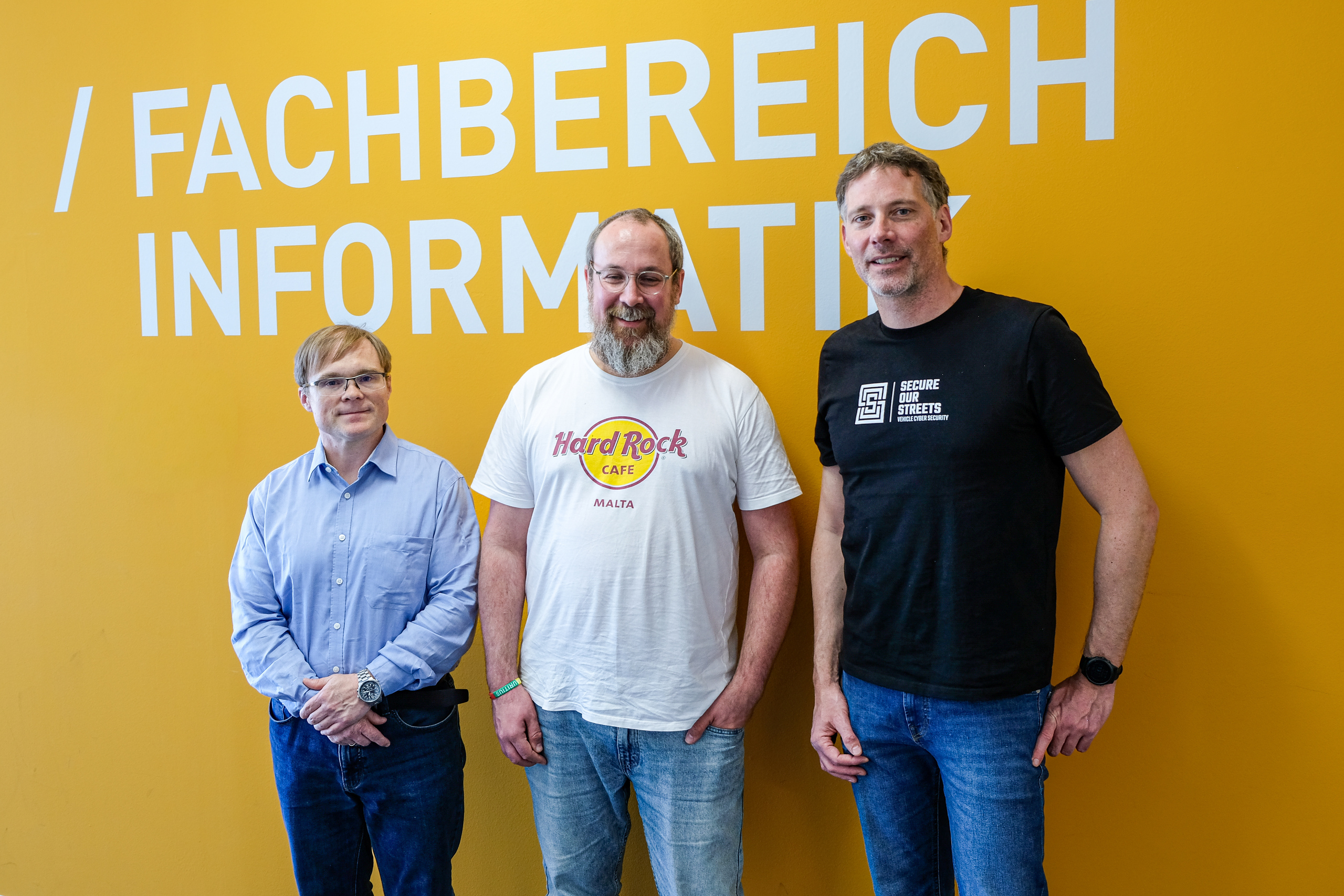
The researchers have divided the project work among themselves: Professor Peter Schwabe from the MPI-SP is responsible for the secure implementation of cryptographic algorithms. Christoph Krauß from h_da is working on the protocols while Marc Stöttinger from HSRM is taking care of the system architecture and how to integrate the different layers. “Ultimately, all the parts must be connected with each other and fit together so that cryptographic methods remain secure in the long term,” says Krauß, describing the task at hand. Stöttinger compares it to a talk show: “The guests on the show are the algorithms, as it were. The presenter is the protocol who decides when it’s each guest’s turn to speak. And the television studio, with the technical equipment, camera crew, set design and so on, is the architecture.” Only if everyone (and everything) works properly together is the programme a success.
New algorithms alone are insufficient
That is why simply replacing old algorithms with new ones is not enough. To keep with the talk show analogy: if another presenter takes over, new topics are proposed, the round tables are reorganised, the guests behave differently – the whole programme needs a new concept. In a similar way, post-quantum cryptography brings with it new requirements and challenges in all its subdomains: new security features, larger keys, greater computational effort, different processes and new potential vulnerabilities. “Vulnerabilities can arise, for example, when algorithms that are in fact secure and already internationally standardised are not properly integrated into protocols,” explains Christoph Krauß.
Related articles
impact, 16.01.2025: PREPARING FOR THE DIGITAL THREAT
impact, 04.09.2025: HARDER THAN THE HACKERS
impact, 18.11.2025: WORKING ON THE “DIGITAL GUARDIAN ANGEL”
impact, 12.09.2024: "A 'BYPRODUCT' OF OUR RESEARCH"
impact, 05.01.2023: ENHANCING CYBER SECURITY – A GAME OF CAT AND MOUSE
That is why cryptographic agility is one of the project’s main themes. In the future, systems should be designed in such a way that they can be easily adapted to new threat scenarios. “We must be able to update systems without having to fully replace major components,” explains Stöttinger. The goal is modular updates rather than complete overhauls. Like an app can be updated without having to buy a new device.
“What distinguishes the project is its holistic approach,” says Peter Schwabe from the MPI-SP. This is reflected in the project’s title: “Holistic Security Solutions for Software-Hardware Implementations (H3SI)”. In the research community, this is still a niche topic, says Christoph Krauß. “There are many people who specialise in their own area. Bringing them all together is new – and necessary.”
Exchange, workshops, global community
That is why the project accentuates international networking, alongside the technical work. Workshops in Germany and Taiwan are planned – in collaboration with Academia Sinica, which has been involved in the project from the outset. Cooperation partners from the US and Singapore are also on board. In this way, the project aims to foster exchange, create awareness, strengthen the community – and advance the topic of post-quantum cryptography on an international level.
So, is the quantum computer merely a risk or might it also be an opportunity to rethink the digital world? “It is also an opportunity,” affirms Christoph Krauß. “The quantum computer can not only attack but also help to test and improve security systems.” The migration to post-quantum cryptography is therefore also a reason “to revisit and modernise our cryptographic infrastructure,” explains Peter Schwabe.
What a quantum computer will never do, however, is calculate Excel spreadsheets in the office, jokes Stöttinger. “The quantum computer is like someone with a particular talent: brilliant for highly specialised and complex tasks but not suited to everyday ones. And, unfortunately, we have to assume that miscreants will use the quantum computer to break algorithms.” The focus of the joint research work is therefore clear, underlines Krauß: “In the first instance, we must bring the threat under control.”
Conventional encryption methods explained in brief
Conventional cryptography distinguishes between symmetric and asymmetric encryption. In symmetric encryption, the sender and recipient use the same secret key, rather like sharing a password. This method is fast and used wherever data is protected directly, e.g., when content is transmitted in encrypted form when visiting a website via HTTPS, when connecting via a Wi-Fi password, or when a device automatically encrypts its hard drive.
Asymmetric methods, by contrast, work with two keys: a public key for encryption and a private key for decryption. In practice, this usually takes place unnoticed in the background, e.g., when the server’s identity is verified and a session key is negotiated while establishing a secure HTTPS connection. Or when the digital signature is verified during software installation, or when only the intended recipient can read encrypted emails.
In the case of quantum computers, however, there is a crucial difference: high-performance quantum computers can effectively break all asymmetric methods in use today, meaning that these are not quantum-proof. Symmetric methods, by contrast, are more robust. Doubling the key length is generally sufficient for them still to be considered secure in the “quantum world”.
Contact our Editorial Team
Christina Janssen
Science Editor
University Communications
Tel.: +49.6151.533-60112
Email: christina.janssen@h-da.de
Translation: Sharon Oranski