


Protect democracy

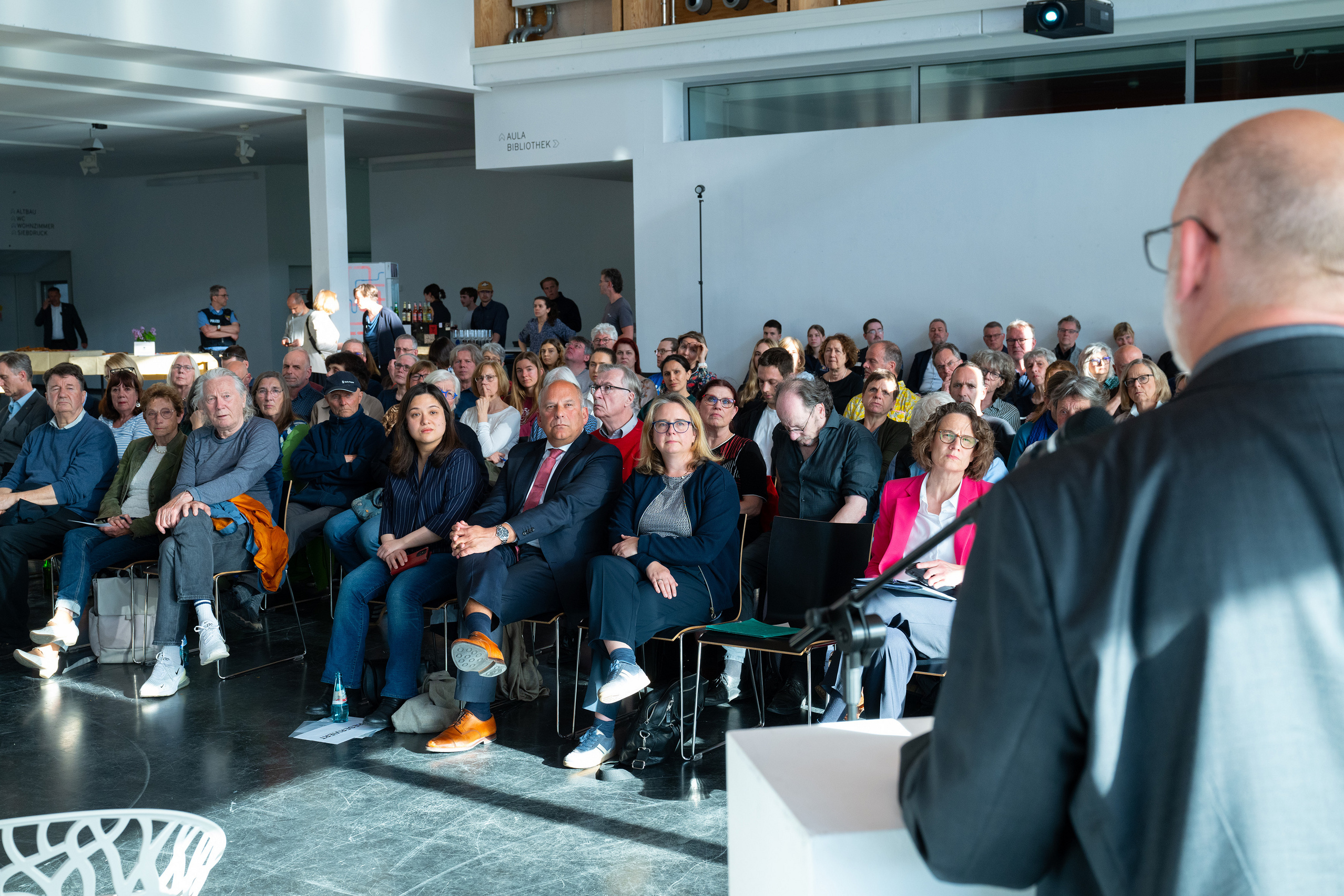
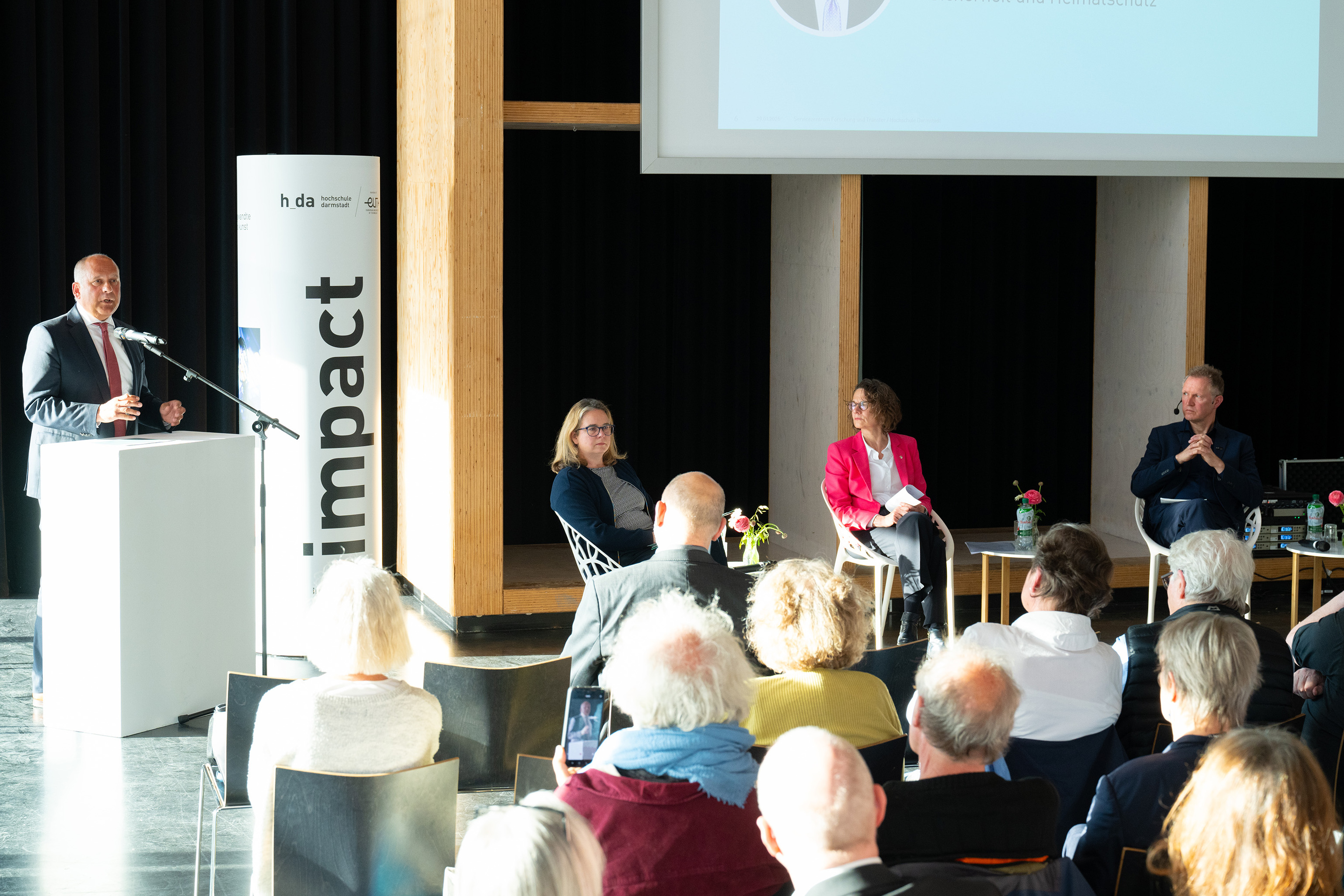
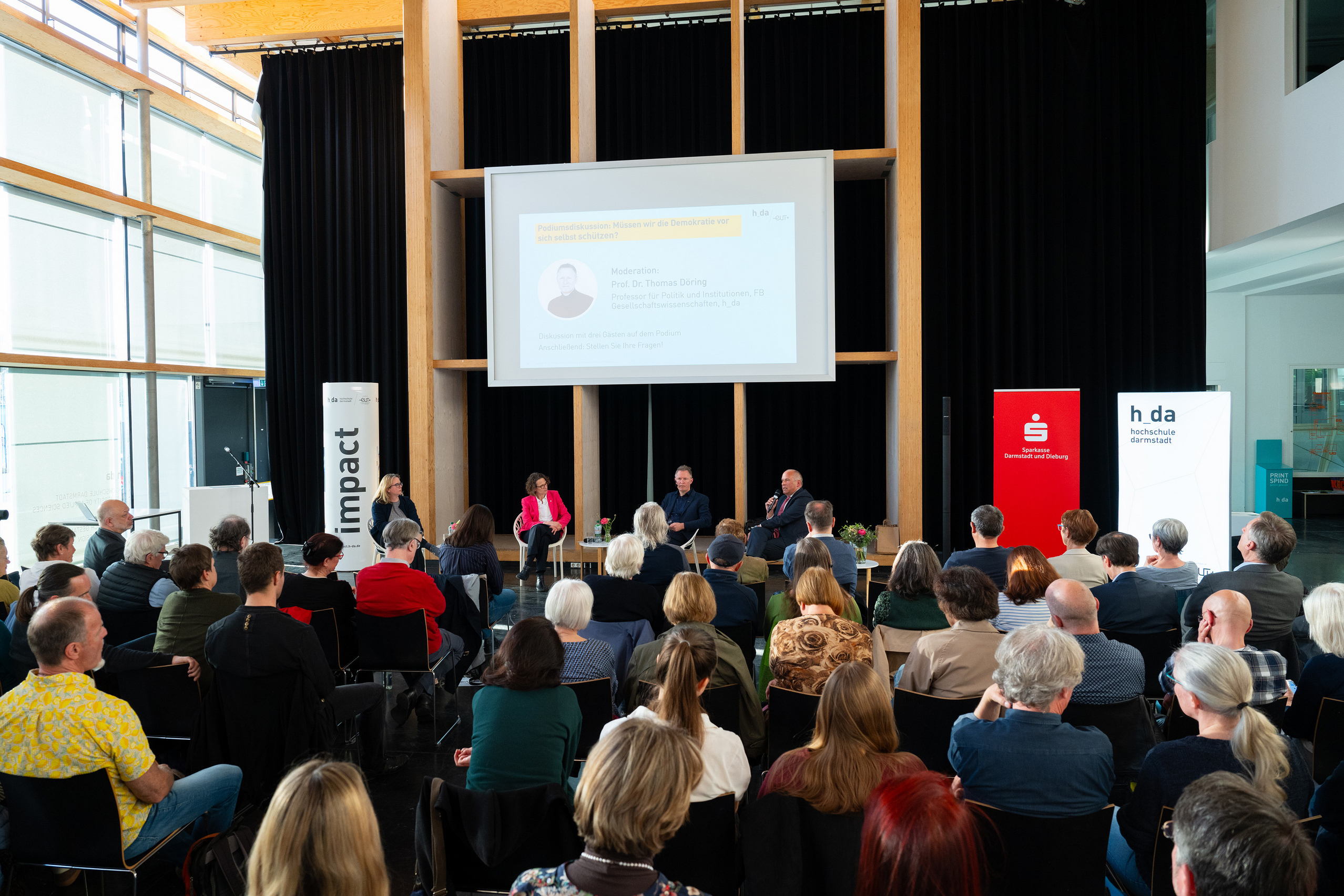
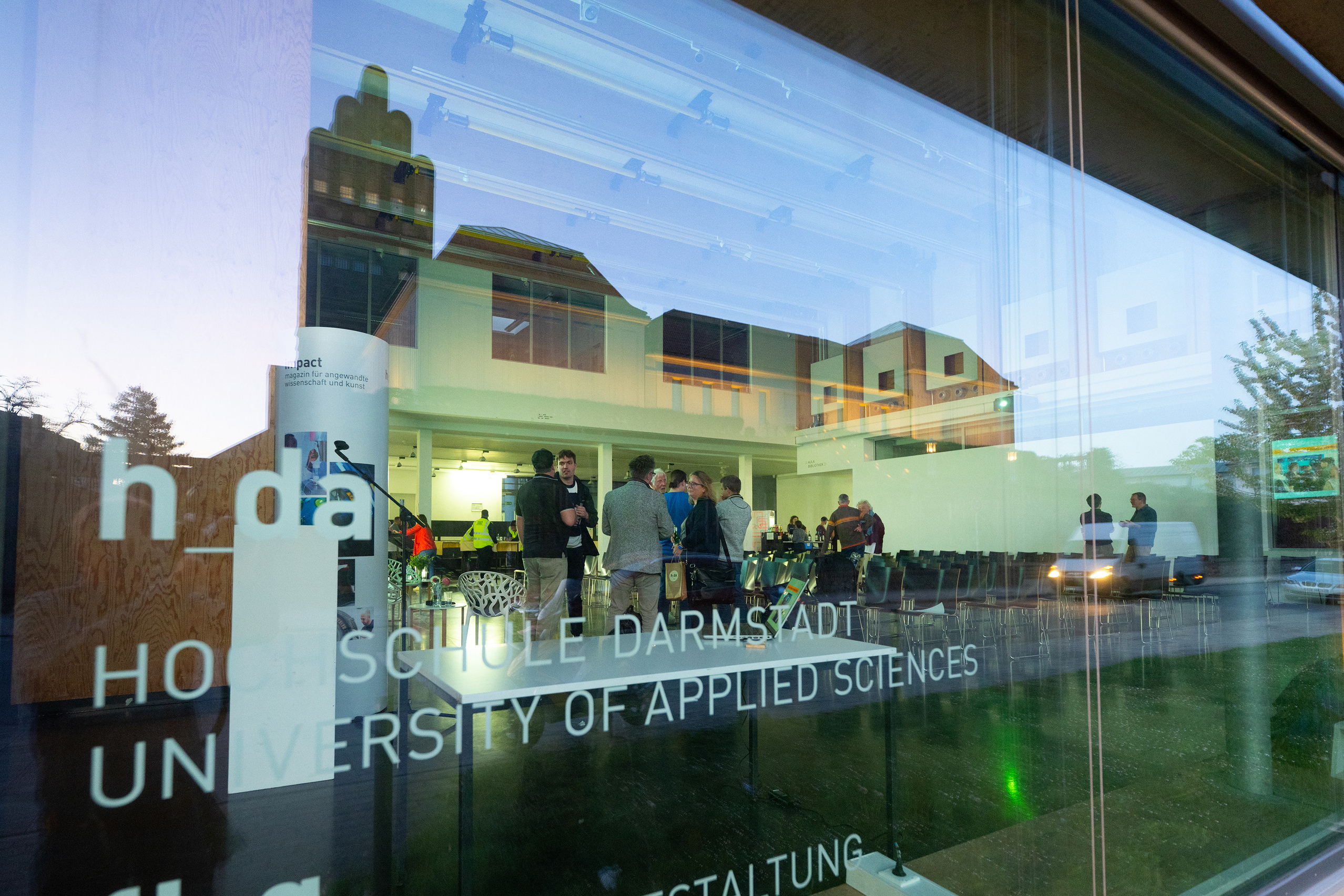
With 100 attendees, the 8th h_da Dialogue Forum on 16 April was very well attended. “Do we need to protect democracy from itself?” was the key question posed at the Faculty of Design. Church President Christiane Tietz, Hesse’s Minister for the Interior Roman Poseck and Charlotte Dany from h_da discussed how stable our democracy is, both within and outside parliament.
By Daniel Timme, 20.4.2026
In his opening address, Prof. Dr Arnd Steinmetz, President of h_da, put his finger on a sore spot for democracy. He noted that significant sections of the population are receptive to authoritarian ideas. “In many of our parliaments, there is now a party that questions fundamental democratic principles.” The fact that we were born into a democracy and have grown up with its benefits should not lead us to take either for granted. Steinmetz’s welcome address was followed by three short presentations from the perspectives of politics, the church and academia.
Hesse’s Minister for the Interior, Prof. Dr Roman Poseck, began his overview of the current situation by looking back 80 years – but it took him only a few steps to reach the present day. He recalled the entry into force of the Hesse Constitution on 1 December 1946. In the wake of the atrocities of National Socialism, he said, it had established a framework for diversity and against extremism and racism. Since 1949, the Basic Law has placed human dignity above all else. “When I began my studies in Giessen in 1990, I could not have imagined that democracy and the rule of law could one day come under such pressure.”
According to the lawyer and politician, the greatest threat today comes from right-wing extremism; yet left-wing extremism is also gaining ground. Nevertheless, as he emphasised several times that evening, he still considers our democracy to be well-established, strong and resilient. “But,” he cautioned, “ultimately, what matters is that we reach out to people and convince them that democracy is the best form of government. To achieve this, the democratic centre must demonstrate its ability to solve problems.”
“What has happened to our hearts?”
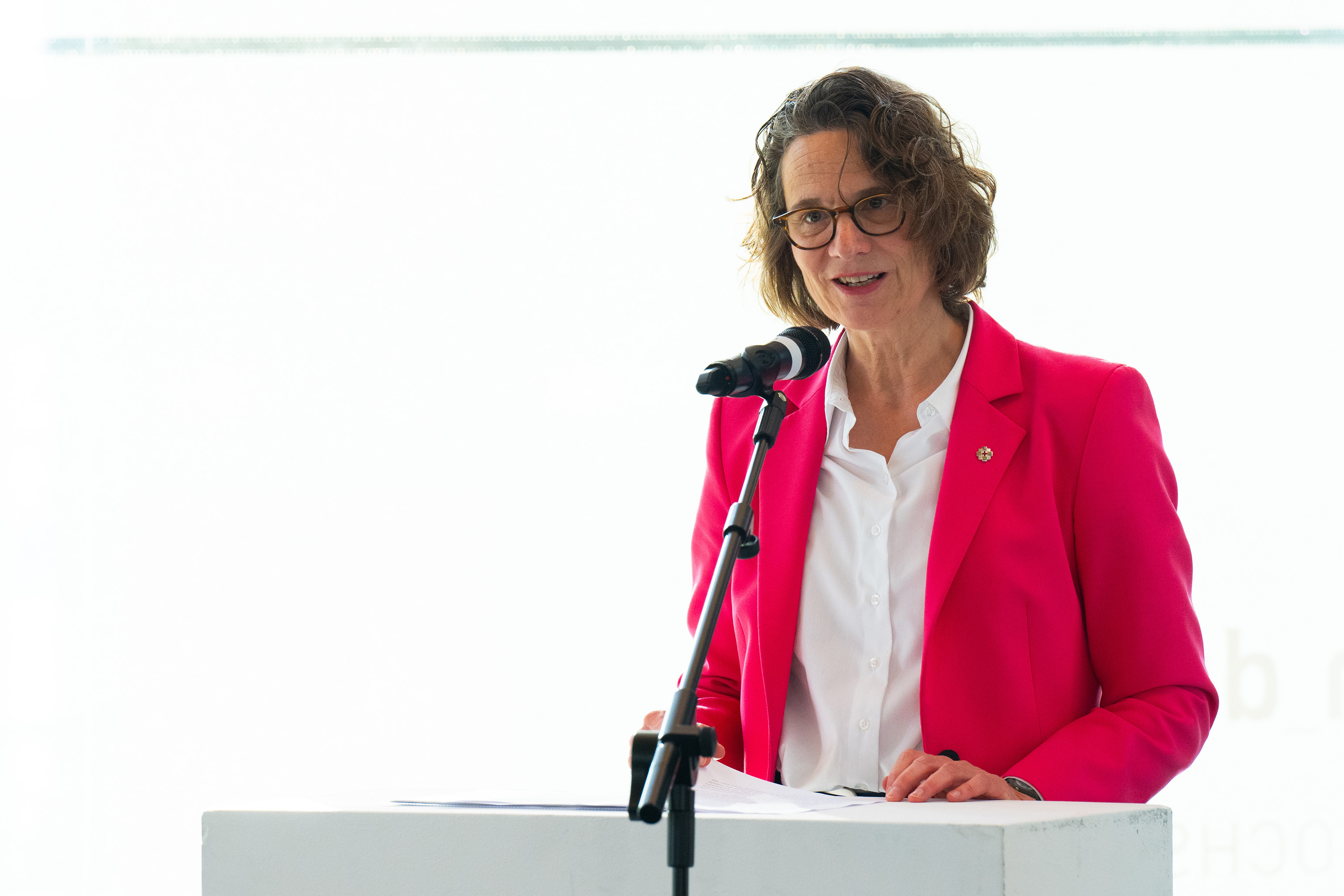
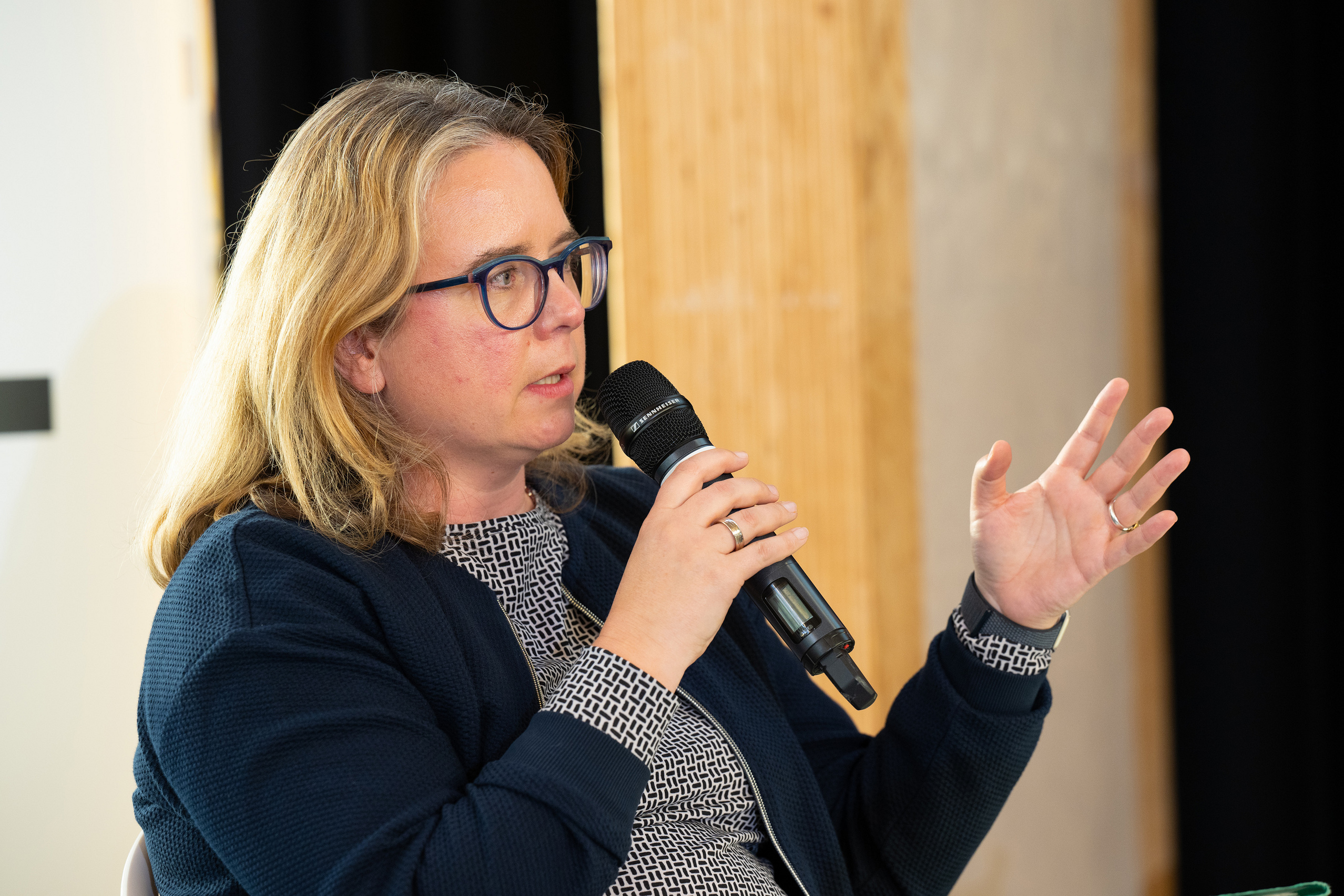
Prof. Dr Christiane Tietz, President of the Protestant Church in Hesse and Nassau (EKHN), examined our democracy and the way we practise it through a church-based lens. She, too, began by looking far back in time, specifically to the United Nations’ Universal Declaration of Human Rights of 1948: “All human beings are born free and equal in dignity and rights.” Not from the pulpit, but from the lectern, Tietz asked: “What has happened to our hearts that we are no longer receptive to this insight?”
“The Church has long struggled with democracy,” she admitted. In the past, she said, “an undifferentiated belief in authority” had prevailed. But it has long been established that “democracy is the form of government that best corresponds to Christianity’s view of humanity.” Drawing on the words of the recently deceased philosopher Jürgen Habermas, Tietz called on the Church to fulfil its duty: “When the social bond unravels and the democratic bond frays, religions have a special responsibility.”
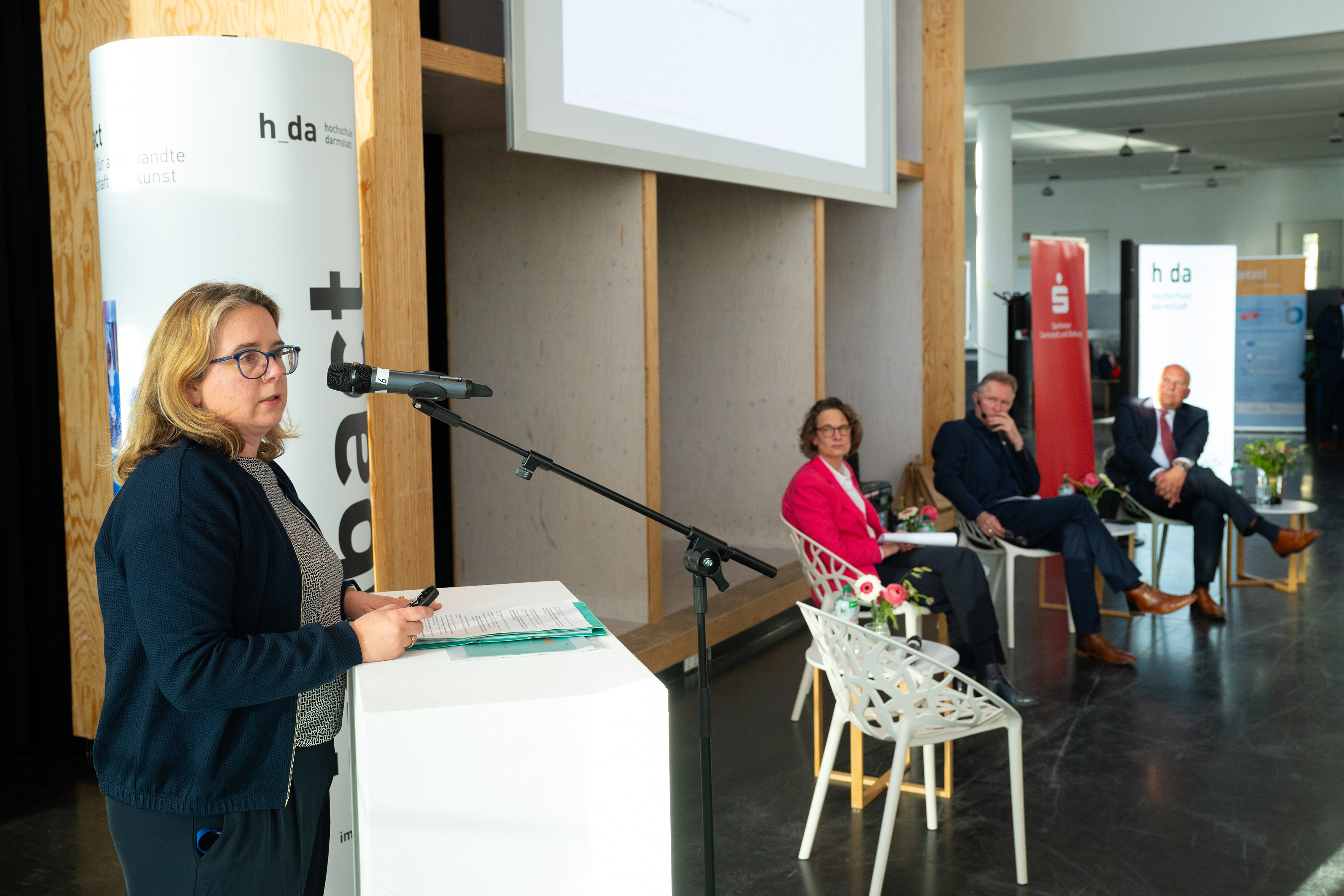
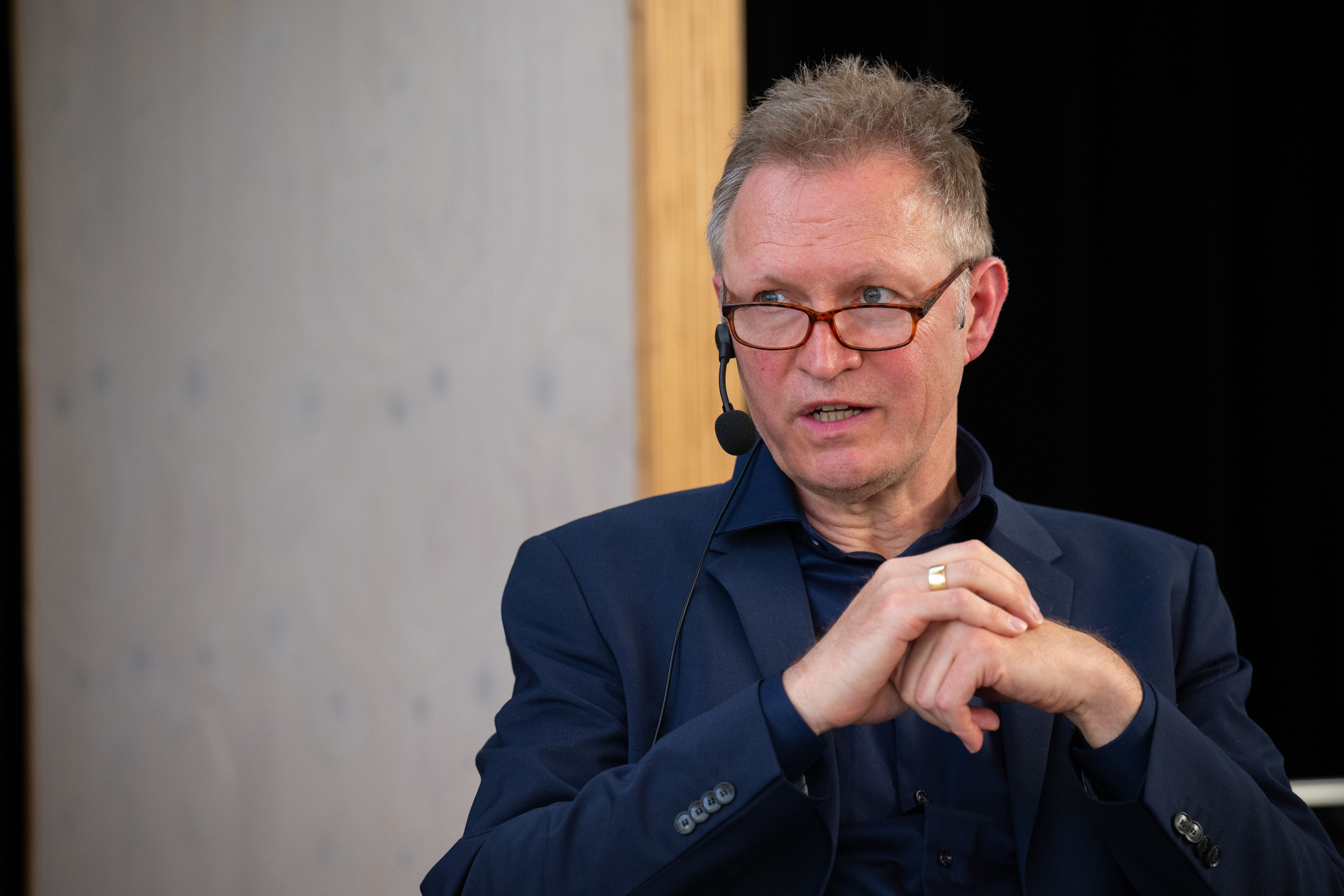
Prof. Dr Charlotte Dany, Professor of Development and Organisational Communication at h_da, provided an academic perspective on the topic. She presented the Hesse-wide research network “DemoReg” (democratic regression) and h_da’s research within it. The research examines setbacks in democracies and the rise of authoritarian forces. The h_da focuses on “civil society as a contested and shrinking space of lived democracy”.
“It is the strategy of the new right to infiltrate and take over the pre-political sphere,” Dany analysed – referring, for example, to sports clubs, fire brigades or cultural initiatives. Furthermore, the right-wing is calling into question political neutrality and state funding for democracy-building work. “We are exploring the challenges facing civil society and the conflicts arising within various groups.” An early finding of the research, which will continue until the end of 2028, is that “dilemmas arise in how we deal with these issues”, as the openness of civil society, in particular, should be preserved.
“Hesse has a stable democracy”
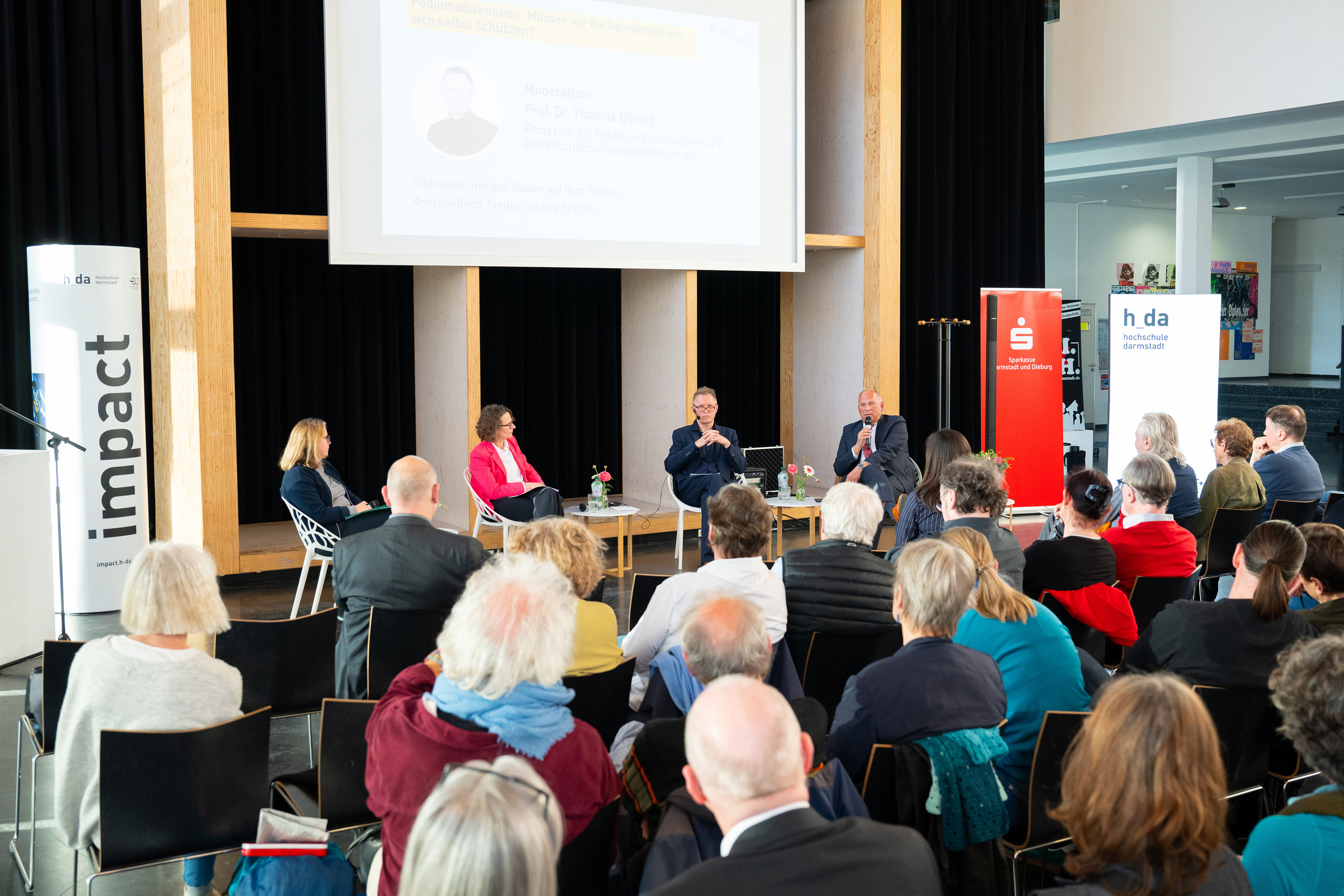
Due to minor delays – a large crowd, a malfunctioning microphone, and a very detailed introduction – Prof. Dr Thomas Döring began the panel discussion slightly later than planned. Referring to the AfD’s continued gains, the moderator asked: “Did we get off lightly in the local elections in Hesse?” The question was first addressed to Roman Poseck. “Hesse has a stable democracy,” he said, whilst emphasising the value of local politics: “The future of democracy is decided at the local level.” Charlotte Dany picked up on this: “If AfD members in a local council are taking charge of supposedly uncontroversial matters such as nurseries or swimming pools, I consider that to be problematic.”
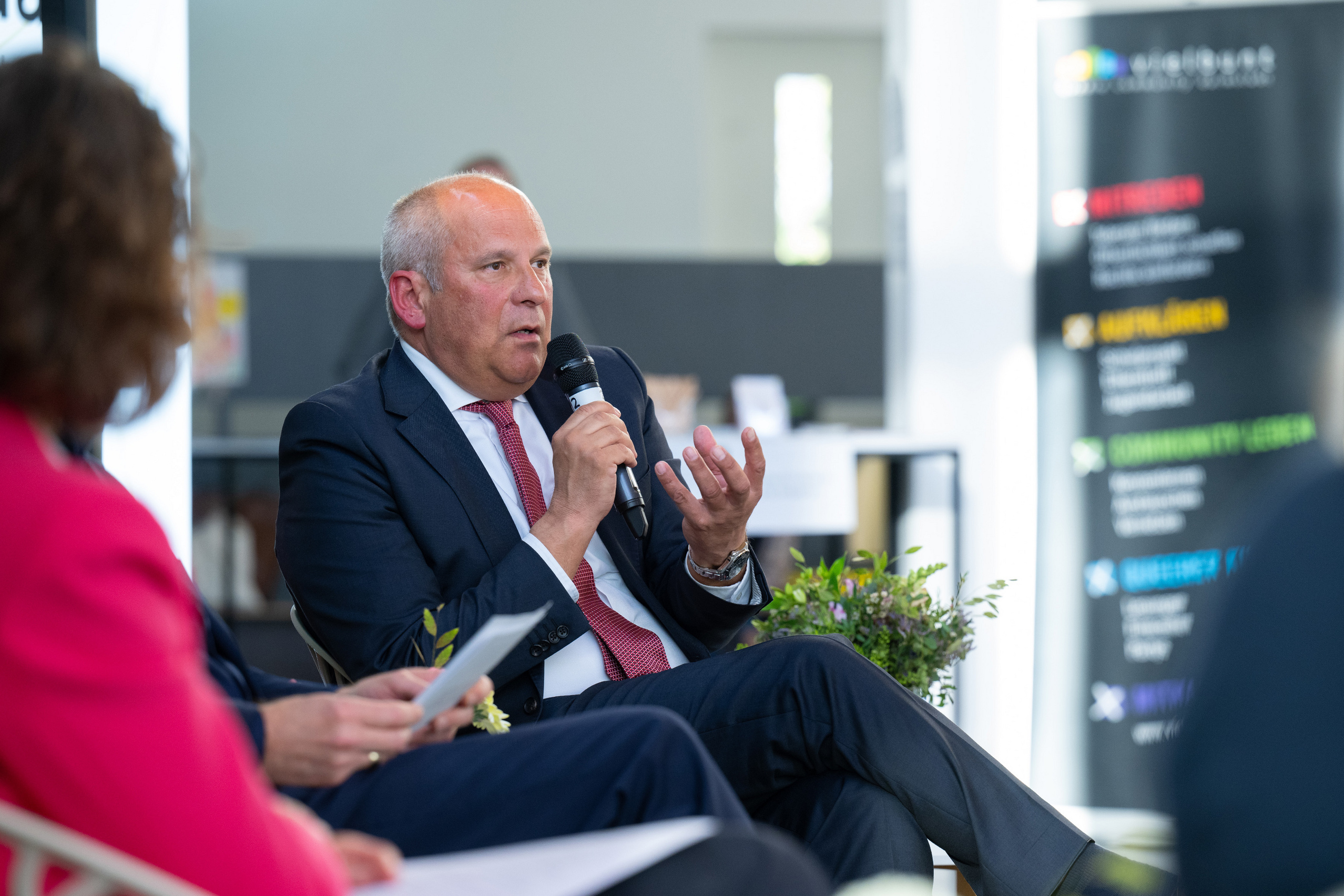
“How do you deal with the AfD sitting in parliament?” Döring asked political expert Poseck. He said he drew a distinction between party officials and ordinary citizens. “I want to make an offer to the people who vote for this party. In the state parliament, I take a very direct approach to the AfD. But perhaps that’s wrong, too, because it gives them attention again.” The Home Secretary described the strong resonance the AfD finds on social media as the “TikTokisation of right-wing extremism”. He said there was as yet no magic formula for dealing with the AfD. Christiane Tietz advocated seeking dialogue rather than polarising. To this end, the EKHN has launched the “VerständigungsOrte” initiative. “There, AfD voters tell us: ‘Finally, someone has listened to me again.’
This bridged the gap between the AfD, which had taken up a great deal of space, and the questions: How can we reach people? How can we motivate them to participate in democratic processes? What opportunities should we offer them? In response to Döring’s question as to why so few young people could be motivated to get involved, Charlotte Dany replied: “I don’t believe that young people have no interest in getting involved. They lack opportunities and support.” Christiane Tietz agreed, saying that in her church’s political youth work she meets young people “who are enthusiastic about democracy”.
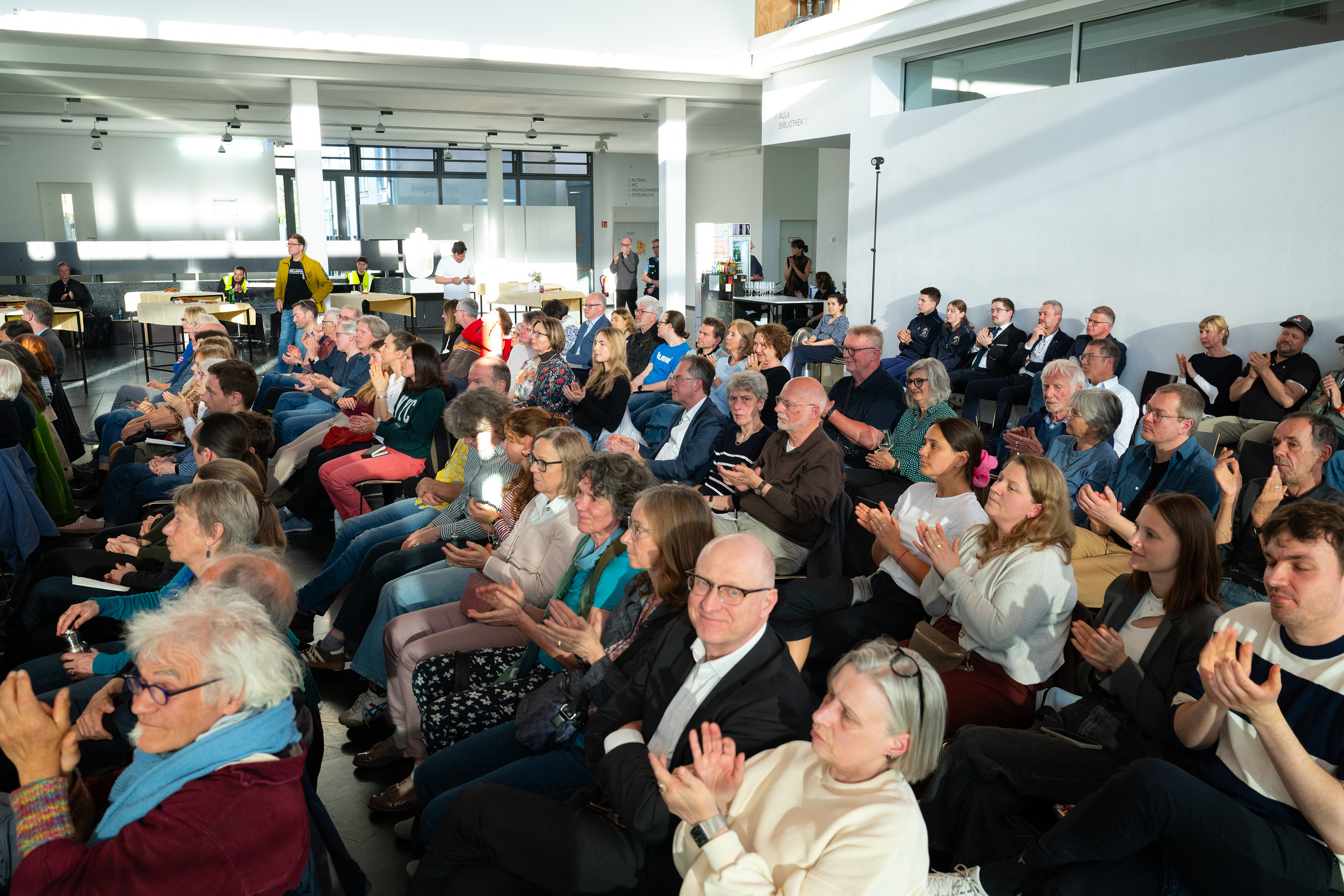
Poseck welcomed the fact that young people are voicing their interests within the parties’ youth organisations or other bodies such as advisory councils and youth parliaments. At the same time, he warned against “parallel structures”. He considered it dangerous “when citizens’ assemblies make supposed decisions on transport or climate – that is a matter for parliaments”. Participation is important – “but not at every level and on every issue”, said Charlotte Dany. “It is more important to ensure that participation is done properly and seriously. Ultimately, participants must also be able to see that they have brought about change.” This was met with approving applause from the audience.


Many comments, but not much time
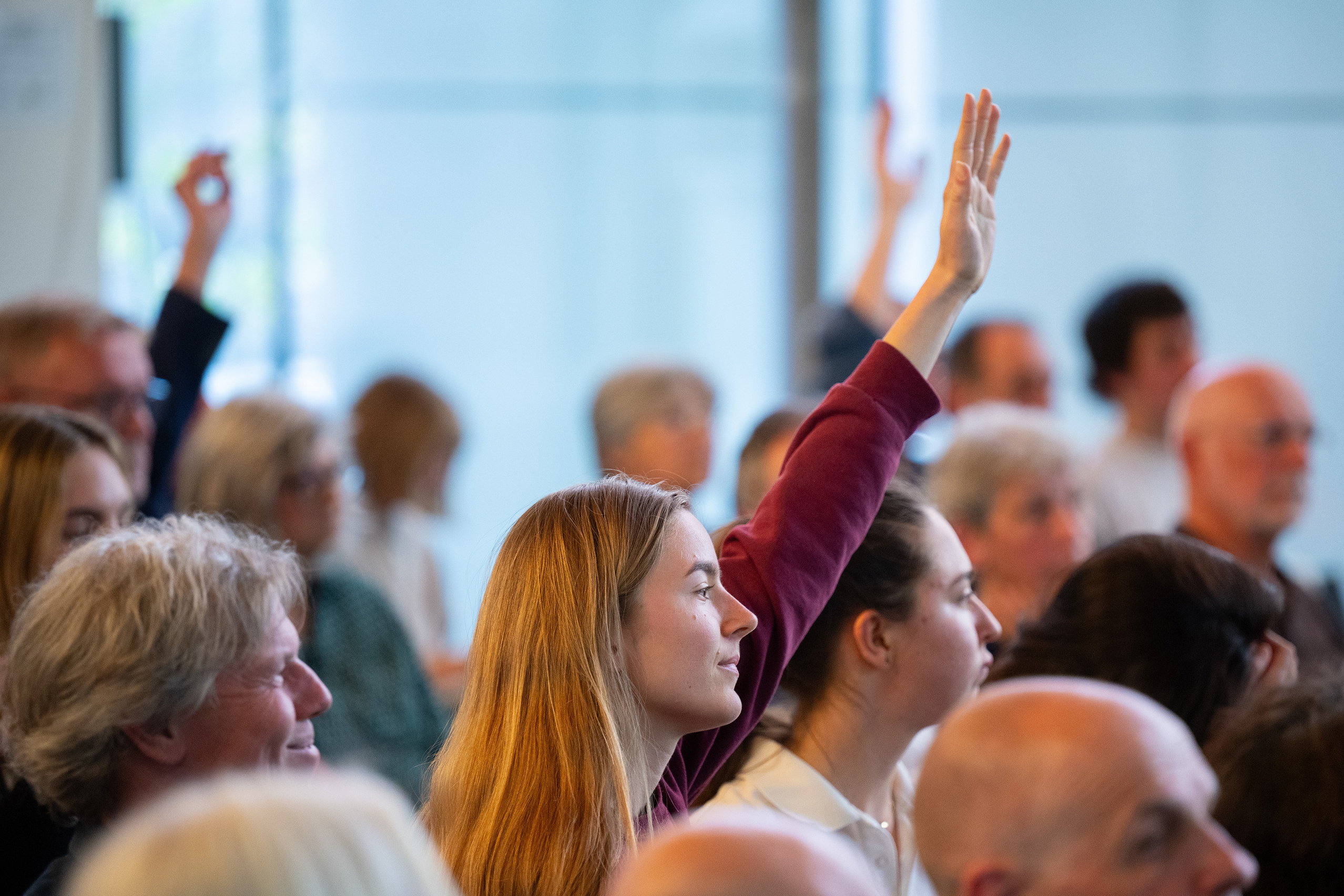
Many of the roughly 100 members of the audience had been waiting impatiently for the discussion to be opened up to the floor. They wanted to contribute their own ideas. There were numerous requests to speak with little time remaining. “I see very few people from my generation here,” criticised a h_da student. She added an observation: “People whom I find very approachable in person take radical positions on social media and spread misanthropic statements.”
One member of the audience attributed the loss of trust in democracy directly to the fact that “politics is being conducted so poorly”, failing to tackle the pressing problems faced by many people, such as the high cost of living. “Yes, we have social problems and we need to address them,” said Roman Poseck. Issues such as high rents are “key causes of the precarious situation many people find themselves in”. However, he immediately qualified this: “Germany is governed significantly better than many other countries. And politics also has only limited options.”
Some of the comments did not lead to a question but instead turned into a “co-presentation”, as moderator Dörig pointed out critically. But even in this way, the audience contributed valuable insights. One student, for instance, suggested involving students as panellists. A valid point of criticism that Charlotte Dany took up: “We ask ourselves why there aren’t more young people here. We need to take a good look at ourselves in this regard. I believe young people need something more accessible.”
It seems that the same applies to democracy on a large scale as it does to the dialogue forum on a smaller scale: creating the right framework for participation is just as challenging as making wise use of it. Both require practice and the determination to bring about change for the better.
Related articles
impact, 8 February 2026: Democracy needs practice
impact, 2 February 2026: Good (or bad) connections?
impact, 2 February 2026: When democracy comes under pressure
impact, 8 December 2025: Democracy on the internet: The true, the false and the perceived
impact, 10 October 2025: Democracy education: Bringing disappointed people back on board
Contact our Editorial Team
Christina Janssen
Science Editor
University Communications
Tel.: +49.6151.533-60112
Email: christina.janssen@h-da.de
Photography: Markus Schmidt
Link to press article
The "Darmstädter Echo" newspaper also reported on the 8th h_da Dialogue Forum. Click here to read the article (DE, paywall).